
'%3e%3cpath%20d='M15.1003%2043.5001C33.2091%2043.5001%2043.1166%2028.4935%2043.1166%2015.4838C43.1166%2015.062%2043.1072%2014.6307%2043.0884%2014.2088C45.0157%2012.815%2046.679%2011.0886%2048%209.11072C46.205%209.90932%2044.2993%2010.4309%2042.3478%2010.6576C44.4026%209.42594%2045.9411%207.49107%2046.6781%205.21166C44.7451%206.35724%2042.6312%207.16535%2040.4269%207.60134C38.9417%206.02324%2036.978%204.97835%2034.8394%204.62822C32.7008%204.27809%2030.5064%204.64222%2028.5955%205.66431C26.6846%206.68641%2025.1636%208.30953%2024.2677%2010.2827C23.3718%2012.256%2023.1509%2014.4694%2023.6391%2016.5807C19.725%2016.3843%2015.8959%2015.3675%2012.4%2013.5963C8.90405%2011.8251%205.81939%209.339%203.34594%206.29916C2.0888%208.46661%201.70411%2011.0314%202.27006%2013.4723C2.83601%2015.9132%204.31013%2018.047%206.39281%2019.4401C4.82926%2019.3905%203.29995%2018.9695%201.93125%2018.212V18.3338C1.92985%2020.6084%202.7162%2022.8133%204.15662%2024.5737C5.59704%2026.334%207.60265%2027.5412%209.8325%2027.9901C8.38411%2028.3864%206.86396%2028.4441%205.38969%2028.1588C6.01891%2030.115%207.24315%2031.8259%208.89154%2033.0528C10.5399%2034.2797%2012.5302%2034.9613%2014.5847%2035.0026C11.0968%2037.7423%206.78835%2039.2284%202.35313%2039.2213C1.56657%2039.2201%200.780798%2039.1719%200%2039.077C4.50571%2041.9676%209.74706%2043.5029%2015.1003%2043.5001Z'%20fill='%23F7F7F7'/%3e%3c/g%3e%3cdefs%3e%3cclipPath%20id='clip0'%3e%3crect%20width='48'%20height='48'%20fill='white'/%3e%3c/clipPath%3e%3c/defs%3e%3c/svg%3e)


A customer finalises a custom staircase in your online configurator. They have chosen oak treads, a steel balustrade, and specific dimensions to fit their home. The order comes through, but now what? Someone on your team has to manually translate those choices into a bill of materials, generate cutting lists, create DXF files for CNC machining, and enter the data into your ERP system. Each handoff is a chance for error, and each error costs time, money, and trust.
This is the reality for most manufacturers offering custom products. The front-end experience may be impressive, but the back-end remains a tangle of spreadsheets, emails, and manual re-entry. Research indicates that human error accounts for 5-30% of total manufacturing expenses through scrap and rework alone. The disconnect between sales and production is not just inconvenient; it is one of the most expensive problems in custom manufacturing.
The Gap Between Sales and Production
In a traditional workflow, the sales team captures customer requirements, a designer interprets them into technical drawings, and a production planner translates those drawings into material lists, machine instructions, and scheduling data. Each stage involves manual re-entry, and each re-entry introduces risk. Studies show that 60-80% of manufacturing issues originate in the sales-to-production handoff, and 65% of engineering change orders are entirely preventable (Joe Barkai).
Consider the scale of the problem: companies processing around 300 new items per month with approximately 150 BOM updates typically encounter roughly 45 mistakes per month, translating to over $100,000 in annual costs. For businesses in the furniture, doors and windows, or staircases industries, where every order is unique, these figures can be even higher. The question is not whether errors will occur, but how many and how costly they will be.
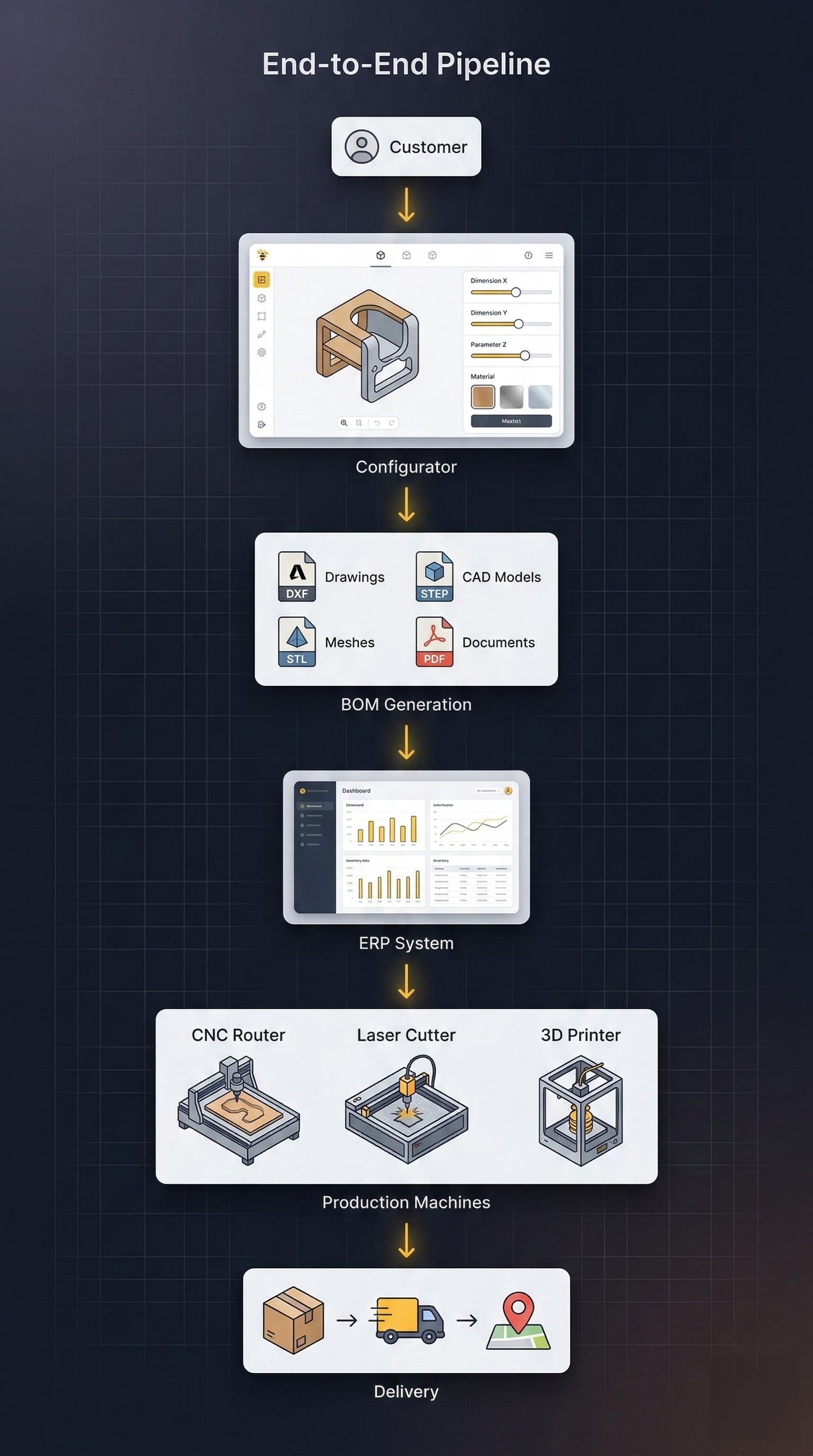
What Is Design-to-Fabrication Automation?
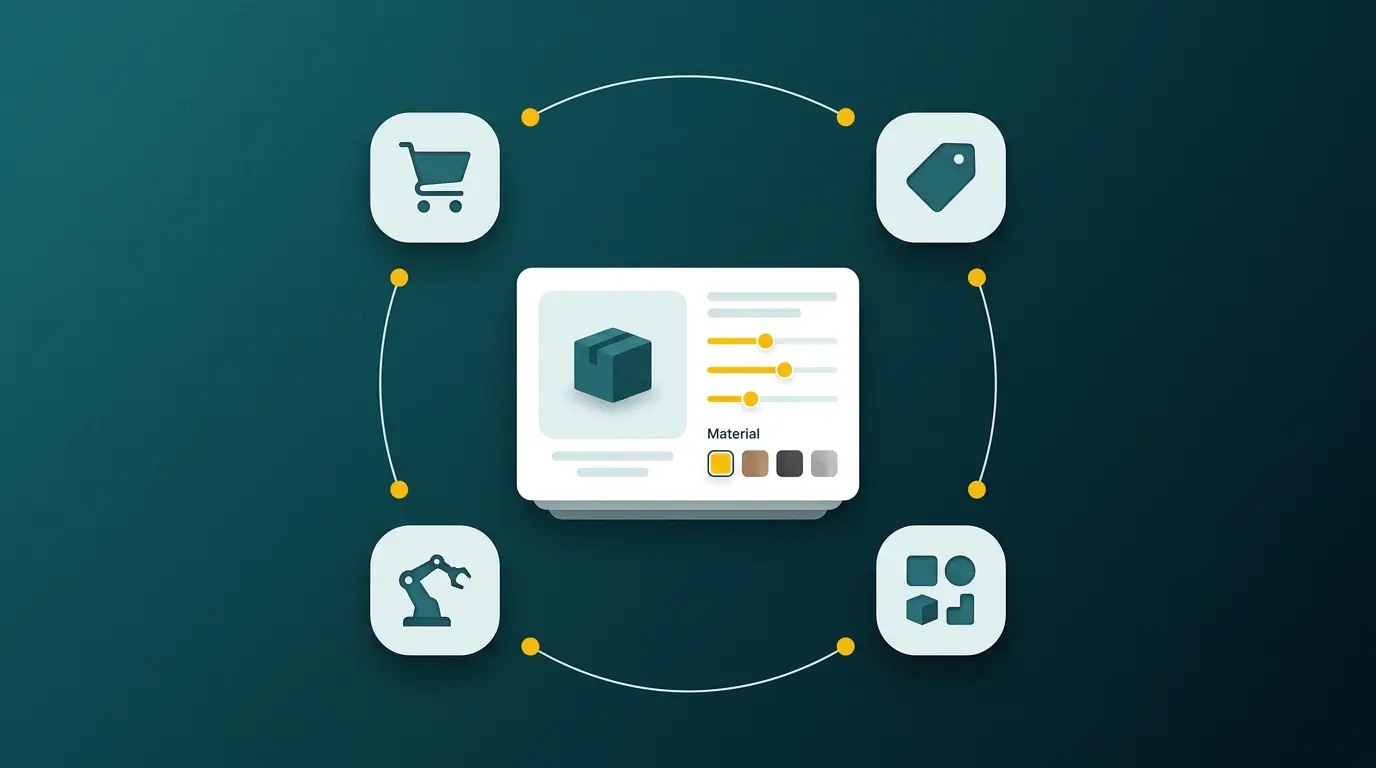
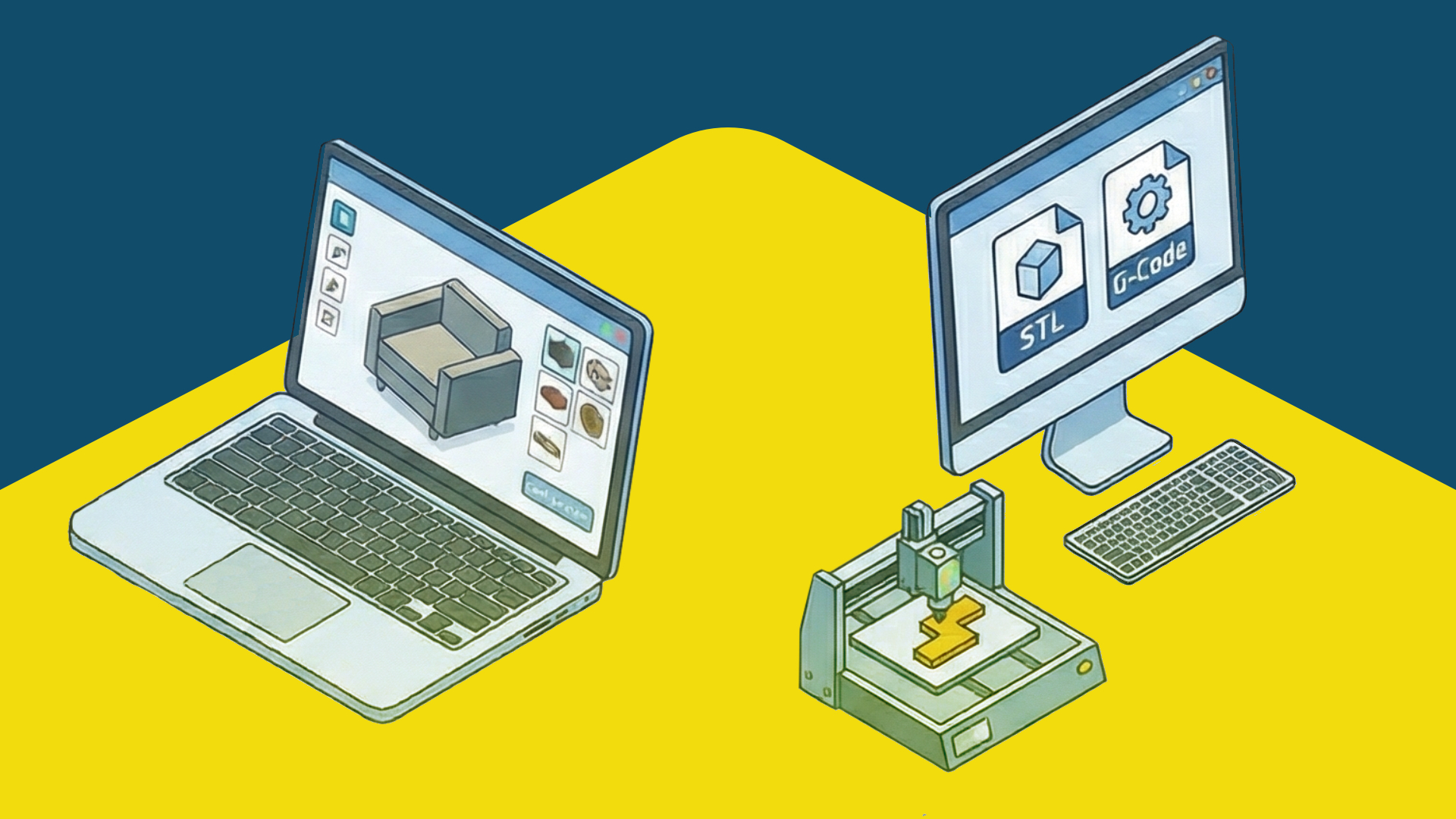
Design-to-fabrication automation eliminates the manual handoffs entirely. Instead of a customer's choices living in one system and production data living in another, a properly built configurator captures every design decision and automatically generates the downstream manufacturing output. When a customer selects a material, adjusts a dimension, or adds a component, the configurator does not just update a visual; it updates a parametric model that encodes real manufacturing logic.
This means the moment an order is confirmed, the system already knows exactly which materials are needed, what operations must be performed, and what files the shop floor requires. There is no interpretation step, no re-entry, and no room for the kind of miscommunication that plagues traditional workflows. The result is a seamless pipeline from customer interaction to factory output.
Automatic BOM and BOS Generation
At the heart of design-to-fabrication automation are two critical documents: the Bill of Materials (BOM) and the Bill of Services (BOS). The BOM lists every component, material, and quantity required to manufacture the product. The BOS lists every operation, from CNC cutting to surface treatment to assembly, along with the associated labour and machine time.
Traditionally, both documents are created manually after the design phase, a process that is slow, error-prone, and difficult to scale. With an automated configurator, the BOM and BOS are generated dynamically as the customer configures the product. Change the wood species from pine to walnut, and the material costs, supplier codes, and finish requirements update instantly. Add a glass panel to a door configuration, and the cutting instructions, edge-banding operations, and assembly steps adjust automatically.
This is not incremental improvement. Configuration systems reduce manufacturing errors by up to 90% and boost profit margins by 3-8%. When every order generates its own accurate BOM and BOS without human intervention, the entire production pipeline accelerates.
How BeeGraphy Powers This
Configurator.tech, powered by BeeGraphy's computational design engine, is built specifically for this kind of automation. Unlike traditional CPQ tools that bolt pricing onto a product catalogue, BeeGraphy uses a node-based parametric architecture where the product model itself contains the manufacturing intelligence.
Three types of nodes make this possible:
- Geometry nodes define the 3D shape and structure of the product, updating in real time as parameters change.
- Material nodes link every geometric element to specific materials, automatically calculating quantities, costs, and supplier references.
- Service nodes define manufacturing operations tied to each component, from laser cutting to powder coating, generating accurate labour and machine-time estimates.
When a customer finalises a configuration, all three node types resolve simultaneously, producing a complete BOM, BOS, and set of production files in a single step. This approach, enhanced in BeeGraphy's October 2025 update, means that the parametric model is not just a visual tool but a complete digital twin of the manufacturing process. Businesses across 3D printing, furniture, and staircase manufacturing are already using this to cut days out of their order-to-production cycle.
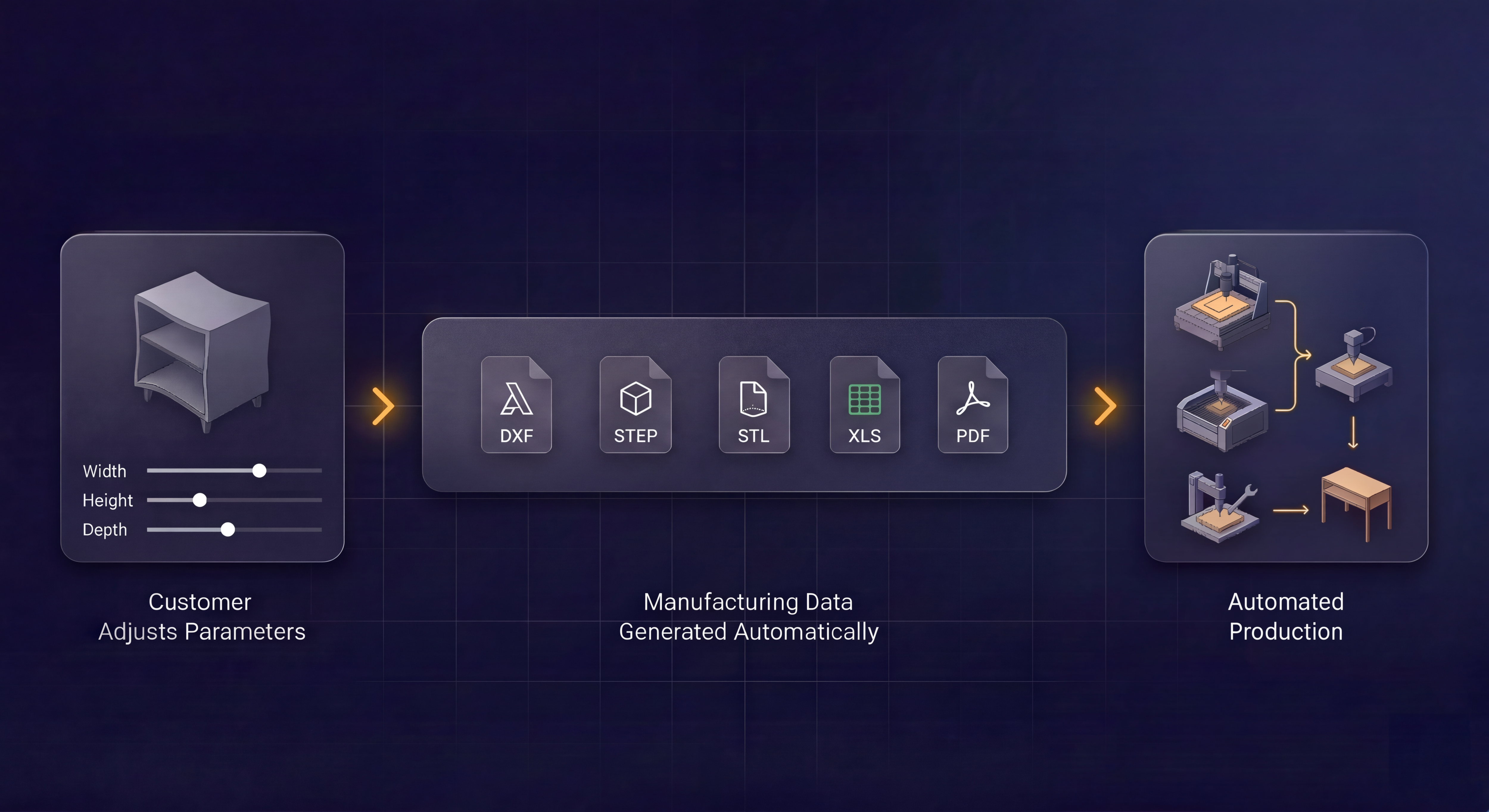
Production-Ready File Output
Accurate data is only useful if it reaches the shop floor in the right format. Modern configurators must output files that machines can consume directly, without manual conversion. This includes:
- DXF files for laser cutting, CNC routing, and waterjet machines
- STEP files for 3D machining, mould making, and quality inspection
- PDF drawings with dimensions, annotations, and assembly instructions for manual fabrication steps
- STL/3MF files for 3D printing and additive manufacturing workflows
With Configurator.tech, these files are generated automatically from the same parametric model that drives the visual configurator. There is no export step, no file conversion, and no risk of a drawing not matching the order. The file that arrives at the CNC machine is mathematically identical to what the customer approved on screen.
ERP and CRM Integration
Production data does not exist in isolation. It needs to flow into enterprise resource planning (ERP) systems for inventory management and scheduling, and into customer relationship management (CRM) systems for order tracking and communication. Manual data entry between these systems is one of the most common sources of downstream errors.
Configurator.tech's API-first architecture enables seamless integration with existing ERP and CRM platforms. When a customer completes a configuration, the BOM, BOS, pricing data, and order details can be pushed directly into systems like SAP, Odoo, or Salesforce without manual intervention. This creates a single source of truth from the customer's screen to the factory floor and back to the sales team. Companies using CPQ solutions with this level of integration report 28% shorter sales cycles and 105% larger deal sizes (Aberdeen Group via Salesforce).
Real-World Impact
The benefits of design-to-fabrication automation are not theoretical. Manufacturers who implement automated BOM and BOS generation alongside production-ready file output consistently report:
- Error reduction of up to 90% in order-to-production data transfer
- 3-8% improvement in profit margins through elimination of scrap, rework, and over-ordering
- Faster quoting and production cycles, with orders moving from confirmation to the shop floor in minutes rather than days
- Scalability that allows businesses to handle growing order volumes without proportionally increasing back-office staff
For businesses selling custom products at scale, the configurator is no longer just a sales tool. It becomes the central nervous system of the entire operation, connecting what the customer wants to what the factory produces with zero information loss in between.
Getting Started
If your business still relies on manual handoffs between sales, design, and production, the cost of inaction grows with every order. The technology to automate this pipeline exists today, and it does not require rebuilding your entire tech stack.
Start by exploring prebuilt configurators to see how parametric models can drive automated production output for your industry. Or, if you are ready to discuss a custom implementation, get in touch with our team to map out how design-to-fabrication automation fits into your existing workflow.
The gap between what your customer designs and what your factory produces does not have to exist. Close it, and you close the door on the errors, delays, and margin leaks that hold custom manufacturers back. Read more about common mistakes that hold back custom product businesses and how to scale your customisation business faster. Visit our pricing page to find the right plan for your needs.