
'%3e%3cpath%20d='M15.1003%2043.5001C33.2091%2043.5001%2043.1166%2028.4935%2043.1166%2015.4838C43.1166%2015.062%2043.1072%2014.6307%2043.0884%2014.2088C45.0157%2012.815%2046.679%2011.0886%2048%209.11072C46.205%209.90932%2044.2993%2010.4309%2042.3478%2010.6576C44.4026%209.42594%2045.9411%207.49107%2046.6781%205.21166C44.7451%206.35724%2042.6312%207.16535%2040.4269%207.60134C38.9417%206.02324%2036.978%204.97835%2034.8394%204.62822C32.7008%204.27809%2030.5064%204.64222%2028.5955%205.66431C26.6846%206.68641%2025.1636%208.30953%2024.2677%2010.2827C23.3718%2012.256%2023.1509%2014.4694%2023.6391%2016.5807C19.725%2016.3843%2015.8959%2015.3675%2012.4%2013.5963C8.90405%2011.8251%205.81939%209.339%203.34594%206.29916C2.0888%208.46661%201.70411%2011.0314%202.27006%2013.4723C2.83601%2015.9132%204.31013%2018.047%206.39281%2019.4401C4.82926%2019.3905%203.29995%2018.9695%201.93125%2018.212V18.3338C1.92985%2020.6084%202.7162%2022.8133%204.15662%2024.5737C5.59704%2026.334%207.60265%2027.5412%209.8325%2027.9901C8.38411%2028.3864%206.86396%2028.4441%205.38969%2028.1588C6.01891%2030.115%207.24315%2031.8259%208.89154%2033.0528C10.5399%2034.2797%2012.5302%2034.9613%2014.5847%2035.0026C11.0968%2037.7423%206.78835%2039.2284%202.35313%2039.2213C1.56657%2039.2201%200.780798%2039.1719%200%2039.077C4.50571%2041.9676%209.74706%2043.5029%2015.1003%2043.5001Z'%20fill='%23F7F7F7'/%3e%3c/g%3e%3cdefs%3e%3cclipPath%20id='clip0'%3e%3crect%20width='48'%20height='48'%20fill='white'/%3e%3c/clipPath%3e%3c/defs%3e%3c/svg%3e)



A customer lands on your website, opens your product configurator, and starts building something custom. They pick a material, adjust the dimensions, add a premium finish. Every change they make raises the same silent question: how much does this cost?
If the answer is "request a quote and wait 48 hours," you have already lost most of them. Today's buyers expect instant answers. Real-time pricing inside a configurator is no longer a nice-to-have feature; it is the difference between closing a deal and watching a prospect disappear.
The Problem with Manual Quoting
Traditional quoting workflows are slow, error-prone, and expensive. A customer sends in their requirements, a sales rep interprets those requirements, calculates material costs, checks with the production team, applies the correct margin, and sends back a quote days later. By that time the customer has already contacted three competitors.
According to Salesforce, sales reps spend just 28% of their time actually selling. The rest goes to administrative tasks like building quotes, chasing approvals, and fixing errors in spreadsheets. Meanwhile, research from Valorx shows that manufacturing companies using manual quoting processes see significantly higher error rates in their proposals, directly impacting conversion rates.
Manual quoting does not just slow you down. It introduces inconsistency. Two sales reps quoting the same product can arrive at different numbers depending on which spreadsheet version they used. This erodes customer trust and creates internal friction that compounds with every order.
What Is Real-Time Pricing in a Configurator?
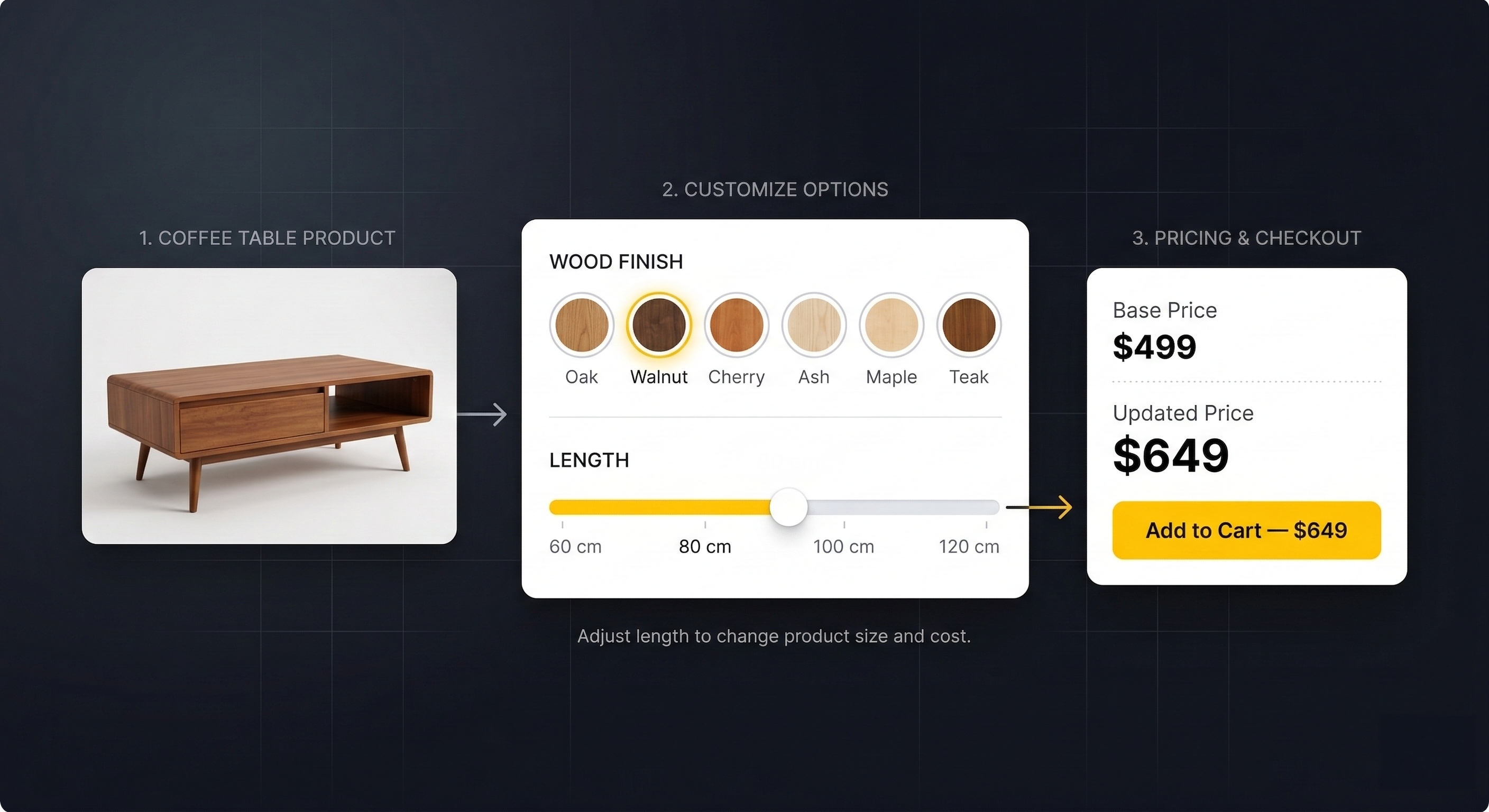
Real-time pricing means the price displayed to the customer updates instantly as they change any parameter in the configurator. Select a different material? The price adjusts. Increase the width by 200mm? Updated. Add tempered glass instead of standard? The new total appears immediately, with no page reload, no waiting, and no guesswork.
This is fundamentally different from showing a "starting at" price and revealing the real cost later. Transparent, live pricing keeps customers engaged because they can experiment freely, understanding exactly how each decision affects their budget. It turns configuration from a blind exercise into an informed design process.
How Pricing Engines Actually Work
Behind every real-time price update is a calculation engine processing multiple variables simultaneously. A well-built pricing engine handles several layers:
- Base material costs: The raw cost of each material option, updated from supplier feeds or internal cost tables.
- Dimensional calculations: Price changes based on size, weight, or volume. A cabinet that is 20% wider does not simply cost 20% more; the engine accounts for material waste, structural reinforcement, and additional hardware.
- Labor and complexity factors: Certain configurations require more machining time, hand finishing, or assembly steps. The engine assigns time-based costs to each operation.
- Margin rules: Different product lines, customer tiers, or regions may carry different margins. The engine applies the correct markup automatically.
- Volume and quantity discounts: Ordering ten units should not require a manual discount calculation. The engine applies tiered pricing based on predefined break points.
The result is a price that reflects the true cost of manufacturing that specific configuration, calculated in milliseconds. Companies using CPQ (Configure, Price, Quote) systems generate quotes 10x faster and cut approval cycles by 95%, according to DealHub.
BeeGraphy's Calculation Panels: AI-Powered Pricing Logic
Configurator.tech, powered by BeeGraphy's engine, takes pricing logic further with its calculation panels. These panels allow businesses to define complex pricing rules without writing a single line of code. You set up material cost tables, define formulas that reference dimensions and selected options, and the system handles everything in real time.
The February 2025 update introduced logical operators within calculation panels, enabling conditional pricing that adapts to combinations of choices. For example: if a customer selects hardwood and a waterproof finish, apply a specific coating surcharge that only applies to that pairing. The AI-powered engine evaluates these rules instantly, producing accurate quotes that account for every interdependency.
This is not just about showing a number. The system can automatically generate formatted quote documents, including line-item breakdowns, that are ready to send to the customer or feed into your invoicing workflow. No manual intervention required.
Why Pricing Transparency Matters More Than You Think
Hidden costs are the single biggest conversion killer in e-commerce. Research from the Baymard Institute shows that 48% of US online shoppers abandon their carts because of unexpected extra costs revealed at checkout. The average cart abandonment rate sits at 70.22% across all industries. For configurable products where the price is unknown until the end, abandonment rates can be even higher.
On the other side, Omnia Retail reports that 83% of consumers prefer brands that offer clear and simple pricing, and transparent pricing strategies increase customer retention by 60%. When buyers can see exactly how their choices affect the final price, they trust the process. Trust converts browsers into buyers.
Real-time pricing in a configurator eliminates the most common source of friction: the unknown. Every option the customer selects is immediately reflected in the total, so there is never a moment of sticker shock. This is especially critical for businesses selling customizable products where the price range between a basic and fully loaded configuration can differ by several multiples.
The Impact on Sales Cycles and Deal Size
Speed and accuracy in quoting do not just improve the customer experience; they directly impact revenue. Data from Aberdeen Group via Salesforce shows that companies using CPQ tools see a 105% increase in average deal size and a 49% higher proposal volume. Salesforce also reports that CPQ shortens sales cycles by 28%.
These numbers make sense when you consider the mechanics. When a customer can configure and price a product themselves, they explore more options. They add features they would not have considered if they had to wait for a revised quote each time. The configurator becomes a discovery tool, and the live pricing removes the anxiety of experimentation. The result is larger orders completed in less time, with fewer touchpoints from your sales team.
For manufacturers and custom product businesses, this shift is transformative. Instead of a sales rep spending hours on a single quote, the configurator handles hundreds of pricing scenarios simultaneously. Your team focuses on high-value conversations while the technology manages the calculations.
From Quote to Production: Where Pricing Data Goes Next
Real-time pricing is not an isolated feature. In a well-integrated system, the pricing data generated during configuration flows directly into downstream processes. The same calculation that produced the customer-facing price also generates internal cost breakdowns, bill of materials data, and production estimates.
This means the quote is not just a number shown on screen. It becomes the foundation for invoicing, purchase orders, and ERP entries. When the customer confirms their order, there is no manual re-entry of pricing data. The configuration, the price, and the production specifications all move together as a single package through your business workflow, eliminating the transcription errors that plague disconnected systems.
How Configurator.tech Handles Pricing
Configurator.tech provides a no-code approach to building pricing logic directly into your product configurator. You define your cost variables, set up formulas in the calculation panels, and assign rules that respond to customer selections. The platform supports multi-currency pricing, regional tax rules, and customer-specific discount tiers, all managed from a single dashboard.
Every price update happens in real time as the customer interacts with the 3D model. There is no separation between the visual configuration and the pricing engine; they are one integrated experience. When a customer scales their customization, the price follows every change without delay.
For businesses that have been relying on spreadsheets and manual quoting, the difference is immediate. Quoting errors drop by 36% in manufacturing environments that adopt CPQ tools, and conversion rates increase by 17%. Combined with the speed advantage, the ROI on automated pricing typically shows within the first quarter of deployment.
If you are ready to replace slow, inconsistent quoting with a system that prices every configuration instantly and accurately, get in touch with our team. We will show you how real-time pricing works inside a configurator built for your specific products and workflow. You can also explore our pricing plans or browse our prebuilt configurator templates to see what is possible out of the box.
Pricing should never be the reason a customer walks away. With the right configurator, it becomes the reason they stay.