
'%3e%3cpath%20d='M15.1003%2043.5001C33.2091%2043.5001%2043.1166%2028.4935%2043.1166%2015.4838C43.1166%2015.062%2043.1072%2014.6307%2043.0884%2014.2088C45.0157%2012.815%2046.679%2011.0886%2048%209.11072C46.205%209.90932%2044.2993%2010.4309%2042.3478%2010.6576C44.4026%209.42594%2045.9411%207.49107%2046.6781%205.21166C44.7451%206.35724%2042.6312%207.16535%2040.4269%207.60134C38.9417%206.02324%2036.978%204.97835%2034.8394%204.62822C32.7008%204.27809%2030.5064%204.64222%2028.5955%205.66431C26.6846%206.68641%2025.1636%208.30953%2024.2677%2010.2827C23.3718%2012.256%2023.1509%2014.4694%2023.6391%2016.5807C19.725%2016.3843%2015.8959%2015.3675%2012.4%2013.5963C8.90405%2011.8251%205.81939%209.339%203.34594%206.29916C2.0888%208.46661%201.70411%2011.0314%202.27006%2013.4723C2.83601%2015.9132%204.31013%2018.047%206.39281%2019.4401C4.82926%2019.3905%203.29995%2018.9695%201.93125%2018.212V18.3338C1.92985%2020.6084%202.7162%2022.8133%204.15662%2024.5737C5.59704%2026.334%207.60265%2027.5412%209.8325%2027.9901C8.38411%2028.3864%206.86396%2028.4441%205.38969%2028.1588C6.01891%2030.115%207.24315%2031.8259%208.89154%2033.0528C10.5399%2034.2797%2012.5302%2034.9613%2014.5847%2035.0026C11.0968%2037.7423%206.78835%2039.2284%202.35313%2039.2213C1.56657%2039.2201%200.780798%2039.1719%200%2039.077C4.50571%2041.9676%209.74706%2043.5029%2015.1003%2043.5001Z'%20fill='%23F7F7F7'/%3e%3c/g%3e%3cdefs%3e%3cclipPath%20id='clip0'%3e%3crect%20width='48'%20height='48'%20fill='white'/%3e%3c/clipPath%3e%3c/defs%3e%3c/svg%3e)


A customer visits two online stores selling the same leather messenger bag. On the first site, the bag is listed at $180 with a handful of static photos. On the second, a 3D configurator invites them to choose the leather type, select the stitching colour, monogram their initials, and watch the bag take shape in real time. The price? $220. The customer doesn't hesitate. They buy the more expensive bag, and they feel better about the purchase.
This scenario plays out millions of times every day across industries, from furniture to jewelry to consumer electronics. Customers consistently pay more for products they have a hand in designing. The question isn't whether a customization premium exists. The question is why it exists, and how businesses can ethically leverage the psychology behind it.
The Customization Premium Is Real, and It's Growing
Research from Bain & Company found that customers are willing to pay 20% more for customized products compared to their standardized equivalents. Those same customers demonstrate 50% higher Net Promoter Scores, meaning they are significantly more likely to recommend the brand to others. This isn't marginal. A 20% price premium with dramatically higher loyalty is a structural competitive advantage.
Meanwhile, McKinsey reports that 71% of consumers now expect personalized interactions, and 76% express frustration when they don't find them. Companies that excel at personalization generate 10-15% more revenue than those that don't. And according to Epsilon research, 80% of consumers are more likely to purchase from brands that offer personalized experiences.
But these numbers only describe what happens. To understand why customers behave this way, we need to look at the behavioral science.
The IKEA Effect: Effort Creates Value
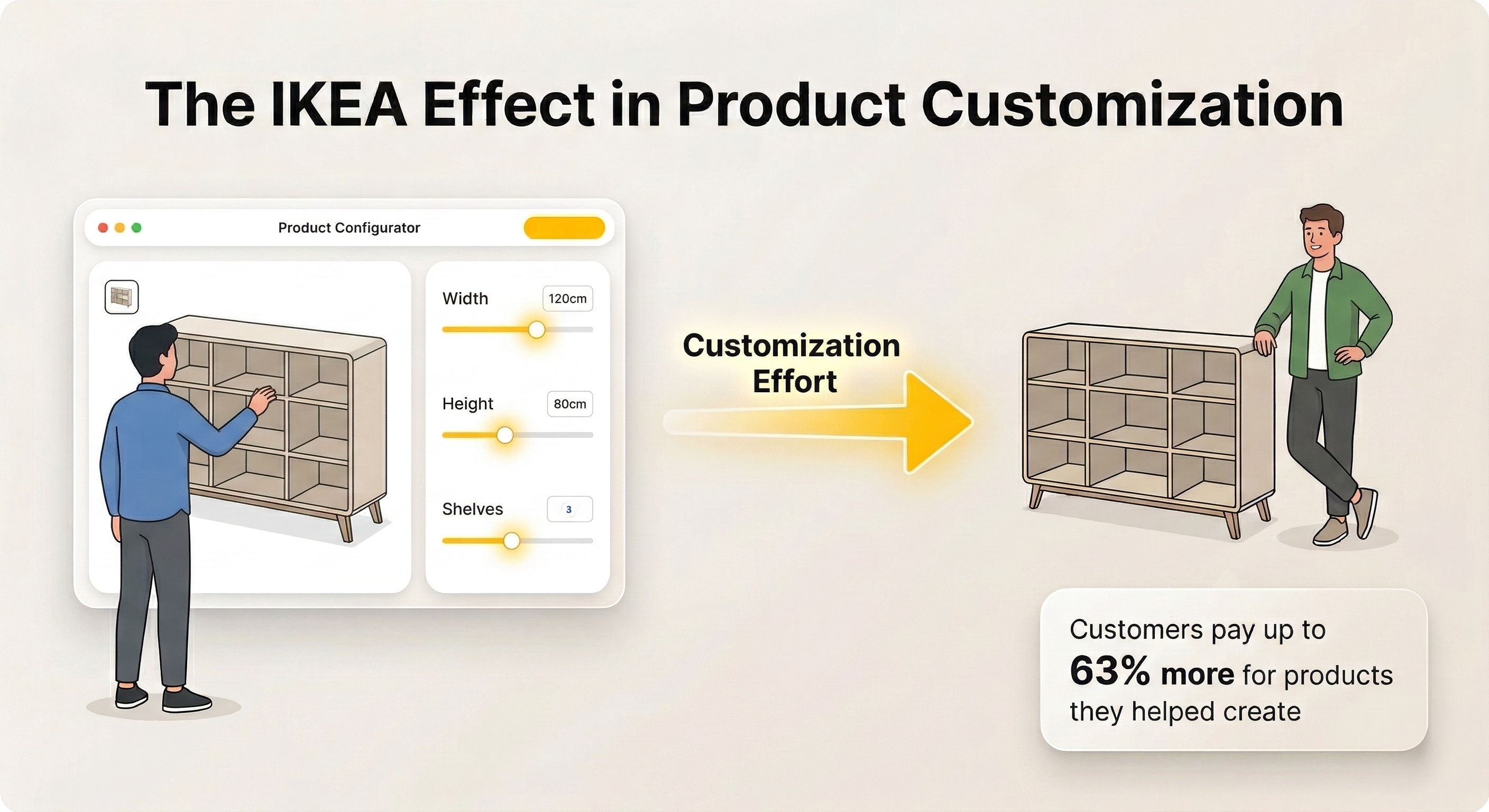
In 2011, researchers Michael Norton (Harvard), Daniel Mochon (Yale), and Dan Ariely (Duke) published a landmark study that would become one of the most cited papers in behavioral economics. They asked participants to assemble simple IKEA storage boxes, fold origami, and build sets of Legos. Then they asked those participants how much they would pay to keep the items they had made.
The result was striking: participants valued their self-assembled creations 63% more than identical items assembled by someone else. The effect held even when the quality of their work was objectively lower. The researchers named it the IKEA Effect: labour alone can be sufficient to induce greater liking for the fruits of one's labour.
The implications for product customization are profound. When a customer spends five minutes configuring a piece of custom furniture, choosing the wood species, adjusting the dimensions, selecting the hardware finish, they are investing effort. That effort, however minimal, fundamentally changes how they perceive the product's value. It is no longer just a table. It is their table, born from their choices.
The Endowment Effect Amplified: Ownership Before Purchase
The IKEA Effect builds on a more foundational cognitive bias: the Endowment Effect, first described by Nobel laureate Daniel Kahneman alongside Jack Knetsch and Richard Thaler in 1990. Their research demonstrated that people demand roughly twice as much to give up an object they own than they would be willing to pay to acquire it. Ownership, even brief or trivial, inflates perceived value.
What makes product configurators so psychologically powerful is that they create a sense of ownership before the purchase is complete. The moment a customer selects a rose-gold finish for their custom ring and watches it render in real time, they begin to feel that the product already belongs to them. It is no longer an abstract offering from a catalogue. It is a specific object that reflects their taste, their decisions, their identity. Giving it up, closing the browser tab, abandoning the cart, now feels like a loss, not merely the absence of a gain.
This is a critical distinction. Traditional e-commerce asks customers to evaluate products from the outside. Configurators invite them inside the creation process, transforming browsers into co-creators and triggering ownership psychology before any money changes hands.
The Personalization Expectation: A Baseline, Not a Bonus
It is worth emphasizing that personalization has shifted from a competitive differentiator to a baseline expectation. The McKinsey data on this is unambiguous: consumers don't just prefer personalized experiences, they are actively frustrated by their absence. This frustration is not passive. It manifests in lower conversion rates, higher bounce rates, and brand switching.
For businesses selling customizable products, this creates both an opportunity and an obligation. Offering a static product page with a dropdown menu for "colour" and "size" is no longer sufficient. Customers expect to see how their choices affect the product. They expect immediacy. They expect involvement. When a brand meets these expectations through an interactive configurator, it doesn't just avoid frustration. It activates the psychological mechanisms that drive premium pricing and loyalty.
How Configurators Activate These Biases
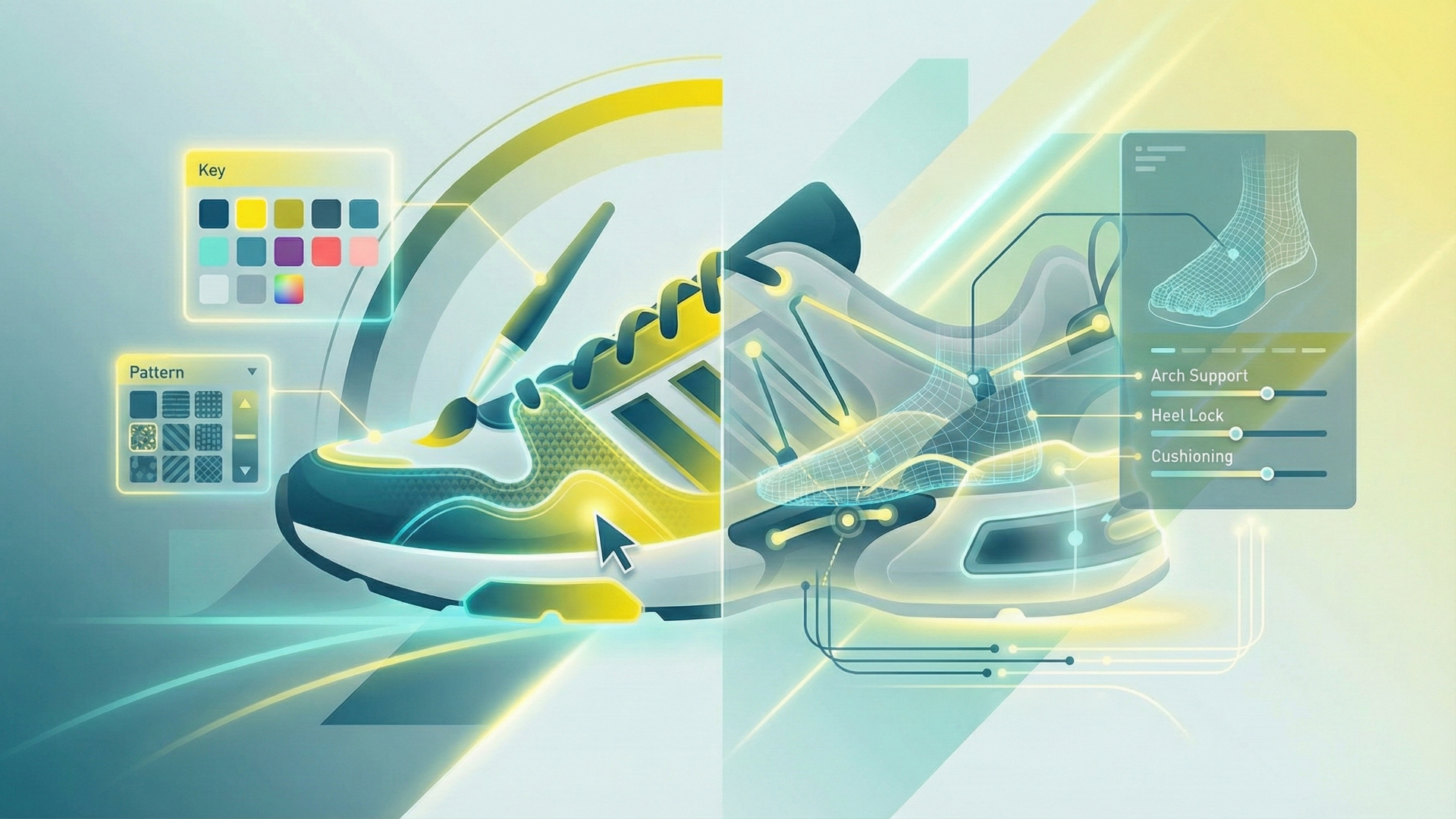
Understanding the theory is valuable. Applying it is what separates high-performing businesses from the rest. Product configurators are not merely functional tools for selecting options. When designed well, they are psychological engines that systematically activate the biases described above.
Effort investment through interaction. Every click, drag, and selection in a configurator represents a micro-investment of effort. The customer chooses the base material, then the accent colour, then the engraving. With each step, the IKEA Effect deepens. By the time they reach the summary screen, they have built something, and the cognitive cost of abandoning it rises with every decision they've made.
Real-time visualization reinforces ownership. Seeing the product change instantly as selections are made is not a cosmetic feature. It is the mechanism through which psychological ownership forms. The customer watches their product emerge, detail by detail. This visual feedback loop is what transforms abstract options into a tangible possession in the customer's mind, long before checkout.
Guided configuration creates emotional progression. A well-designed configurator doesn't present all options simultaneously. It guides the customer through a sequence, from broad choices to fine details, creating a narrative of creation. This progression mirrors the experience of building something, which is precisely the experience that Norton, Mochon, and Ariely found drives inflated valuation.
Instant gratification through feedback. Price updates, completion indicators, and visual confirmations provide continuous positive reinforcement. Each step feels like progress toward a goal the customer has set for themselves. This isn't manipulation. It's good design, aligned with how human cognition naturally works.
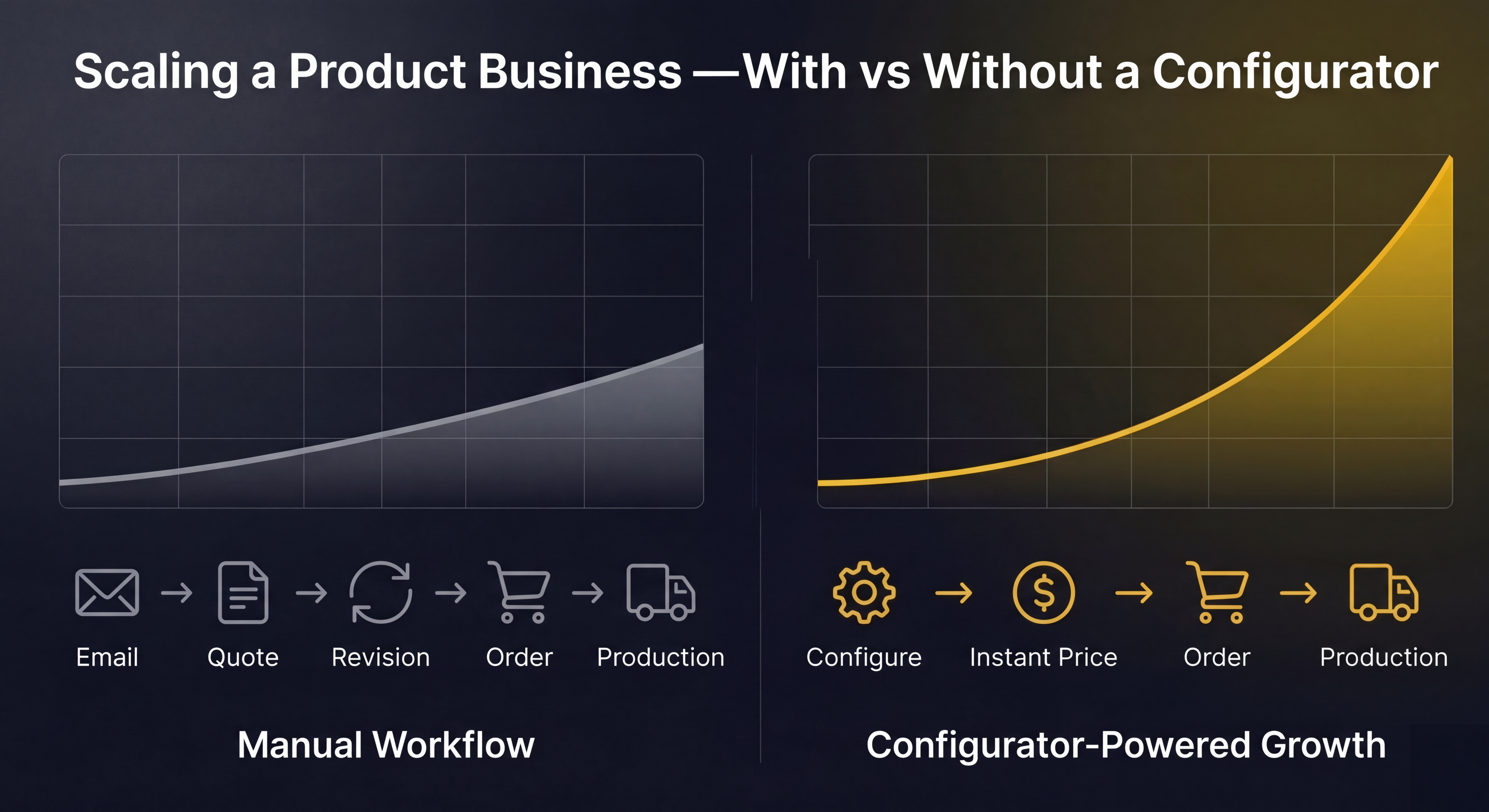
Practical Implications for Businesses
The research points to several actionable principles for any business considering or refining a product configurator:
Make the design process visible and participatory. Don't hide customization behind form fields. Let customers see their product evolve. The more visible the creation process, the stronger the IKEA Effect. 3D visualization is the most effective way to achieve this.
Structure the journey in deliberate steps. A step-by-step guided configuration is not just easier to use. It increases the perceived effort invested, which in turn increases perceived value. Each completed step is a commitment that makes the next step more likely.
Prioritize speed and responsiveness. The ownership illusion breaks if there's a three-second lag between selecting a material and seeing the update. Real-time rendering isn't a luxury. It's a psychological requirement. Any delay disrupts the emotional connection forming between the customer and the product.
Reduce friction, not effort. This distinction matters. You want to eliminate frustrating friction, such as confusing interfaces, broken previews, or unclear pricing. But you should preserve productive effort: meaningful choices, creative exploration, and the satisfaction of seeing a design come together. The sweet spot is a process that feels effortless but involved.
Address post-purchase anxiety. The psychology of customization can also work against businesses if the delivered product doesn't match expectations. Ensuring manufacturing accuracy is essential to maintaining the trust built during configuration.
How Configurator.tech Leverages These Principles
At Configurator.tech, these behavioral insights are embedded into the platform's design philosophy. The 3D visualization engine renders customer choices in real time, creating the immediate visual feedback that triggers psychological ownership. The step-by-step guided configuration process structures the customer journey to maximize the IKEA Effect without overwhelming the user.
Instant price updates as customers modify their design provide the gratification loop that reinforces each decision. And because the platform generates precise manufacturing specifications from customer configurations, the product that arrives matches what the customer designed, preserving the trust and emotional investment built during the process.
Explore our pre-built configurator templates to see these principles in action, or contact our team to discuss how a custom configurator can leverage behavioral science to increase your average order value and customer loyalty.
The Science Is Clear
The customization premium is not a market anomaly or a passing trend. It is a predictable consequence of well-documented cognitive biases. The IKEA Effect makes people value what they help create. The Endowment Effect makes them reluctant to give up what they feel they own. And modern consumers expect the kind of participatory, personalized experiences that activate both.
Businesses that understand this psychology and embed it into their customer experience, through thoughtful, well-designed product configurators, don't just offer customization. They create a form of co-creation that customers value, pay a premium for, and remember. The question is no longer whether to offer customization. It's whether you're designing the experience in a way that unlocks its full psychological potential.