
'%3e%3cpath%20d='M15.1003%2043.5001C33.2091%2043.5001%2043.1166%2028.4935%2043.1166%2015.4838C43.1166%2015.062%2043.1072%2014.6307%2043.0884%2014.2088C45.0157%2012.815%2046.679%2011.0886%2048%209.11072C46.205%209.90932%2044.2993%2010.4309%2042.3478%2010.6576C44.4026%209.42594%2045.9411%207.49107%2046.6781%205.21166C44.7451%206.35724%2042.6312%207.16535%2040.4269%207.60134C38.9417%206.02324%2036.978%204.97835%2034.8394%204.62822C32.7008%204.27809%2030.5064%204.64222%2028.5955%205.66431C26.6846%206.68641%2025.1636%208.30953%2024.2677%2010.2827C23.3718%2012.256%2023.1509%2014.4694%2023.6391%2016.5807C19.725%2016.3843%2015.8959%2015.3675%2012.4%2013.5963C8.90405%2011.8251%205.81939%209.339%203.34594%206.29916C2.0888%208.46661%201.70411%2011.0314%202.27006%2013.4723C2.83601%2015.9132%204.31013%2018.047%206.39281%2019.4401C4.82926%2019.3905%203.29995%2018.9695%201.93125%2018.212V18.3338C1.92985%2020.6084%202.7162%2022.8133%204.15662%2024.5737C5.59704%2026.334%207.60265%2027.5412%209.8325%2027.9901C8.38411%2028.3864%206.86396%2028.4441%205.38969%2028.1588C6.01891%2030.115%207.24315%2031.8259%208.89154%2033.0528C10.5399%2034.2797%2012.5302%2034.9613%2014.5847%2035.0026C11.0968%2037.7423%206.78835%2039.2284%202.35313%2039.2213C1.56657%2039.2201%200.780798%2039.1719%200%2039.077C4.50571%2041.9676%209.74706%2043.5029%2015.1003%2043.5001Z'%20fill='%23F7F7F7'/%3e%3c/g%3e%3cdefs%3e%3cclipPath%20id='clip0'%3e%3crect%20width='48'%20height='48'%20fill='white'/%3e%3c/clipPath%3e%3c/defs%3e%3c/svg%3e)


If your product configurator only speaks one language, you are leaving money on the table — a lot of it. Cross-border ecommerce hit $1.14 trillion in 2024, accounting for roughly 18.8% of all global online sales. By 2033, that figure is projected to surpass $2 trillion, growing at a compound annual growth rate of 21.6%. Buyers around the world are actively searching for products beyond their own borders, and the brands that meet them in their own language will capture the lion's share of that growth.
For companies selling customizable products — furniture, jewelry, souvenirs and promotional items — the opportunity is even greater. Personalized goods command higher margins and build stronger brand loyalty. But to unlock global demand, your configurator needs to speak your customers' languages. Here is why that matters, what it looks like in practice, and how to make it happen.
The Language Barrier in Product Customization
Most product configurators are built in English and stay that way. Option labels, material descriptions, tooltips, error messages, and calls to action are all hard-coded in a single language. For an English-speaking audience, that works fine. For everyone else, it creates friction at exactly the wrong moment — the point of purchase.
Imagine a furniture buyer in Munich trying to configure a custom shelving unit. They understand the 3D model, but the dropdown menus read "Walnut Veneer," "Matte Lacquer," and "Soft-Close Hinges." They might guess correctly, or they might abandon the configurator entirely. Now multiply that scenario across dozens of countries, languages, and product lines. The lost revenue adds up fast.
This is not a niche problem. 59% of global shoppers already buy from retailers outside their home country. If your configurator cannot communicate with them, a competitor's will.
Why Language Matters More Than You Think
The data on language preference in purchasing decisions is striking. Research from CSA Research found that 75% of consumers prefer to buy products in their native language, and 40% will never purchase from a website presented in another language. These are not soft preferences — they are hard boundaries that directly determine whether a visitor converts or bounces.
For product configurators, the stakes are even higher than for standard ecommerce pages. Configurators ask customers to make detailed decisions about materials, dimensions, colors, and features. Every label, every option name, and every instructional tooltip must be understood clearly. A misunderstood material description does not just hurt conversion — it can lead to returns, support tickets, and damaged trust. When a customer is investing time and money into designing a personalized product, clarity is not optional.
What Multi-Language Configurators Actually Look Like
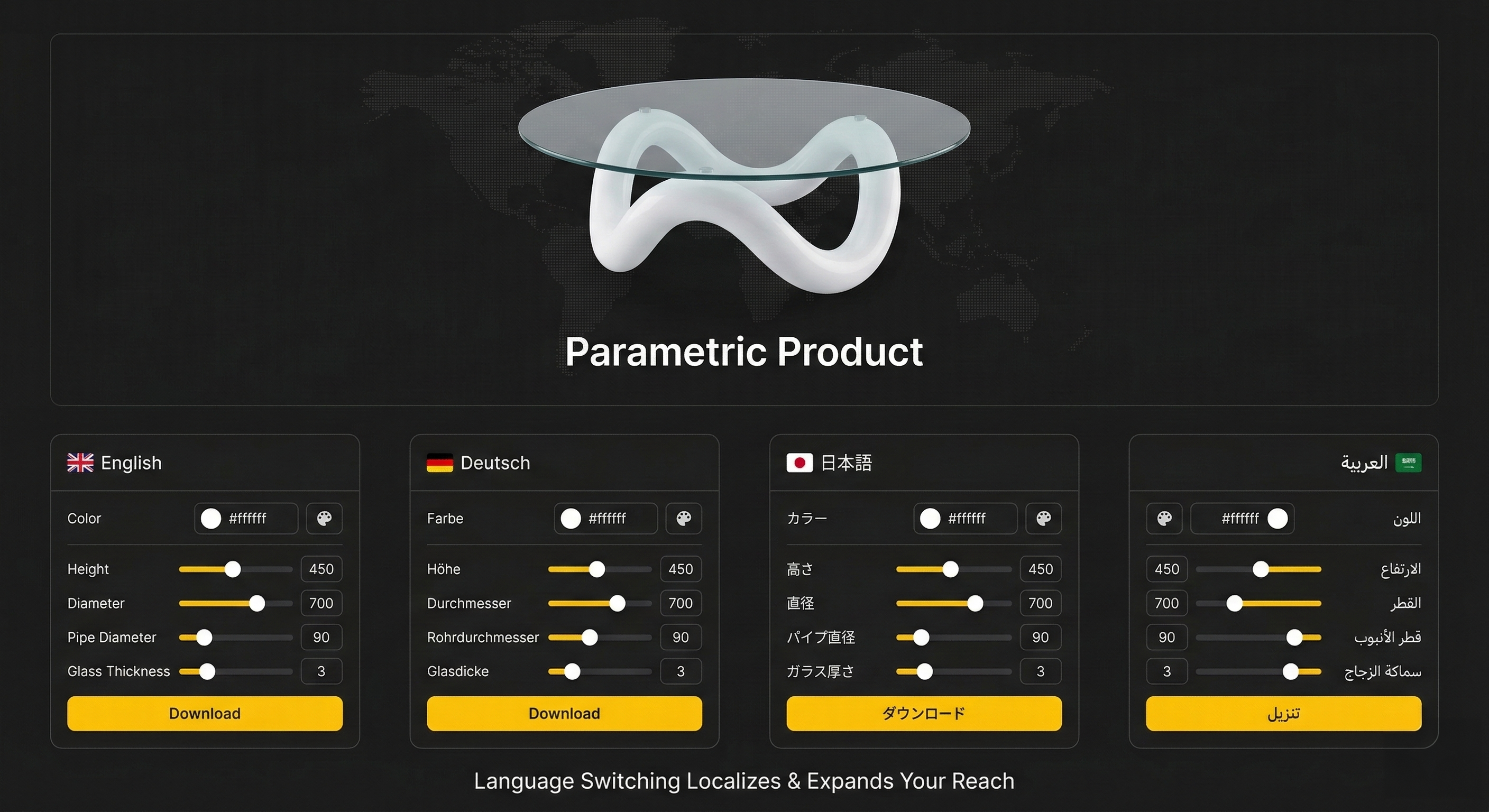
A truly localized configurator goes far beyond running interface text through Google Translate. It includes:
- Localized option labels and descriptions: Material names, finish types, and feature descriptions translated by native speakers who understand the product domain.
- Culturally appropriate imagery and messaging: Visual references and marketing copy that resonate with local audiences rather than defaulting to a single cultural perspective.
- Local currency and pricing: Displaying prices in the buyer's currency with region-appropriate formatting, eliminating the mental math that kills conversions.
- Right-to-left (RTL) support: For Arabic, Hebrew, and other RTL languages, the entire configurator layout must mirror correctly — not just the text, but buttons, sliders, and navigation elements.
- Localized error messages and guidance: When a customer selects an incompatible combination, the explanation needs to be crystal clear in their language.
Each of these elements contributes to an experience that feels native rather than translated — and that distinction is what separates high-converting global stores from ones that merely have an international shipping option.
BeeGraphy's Language Controls: Built for Global Brands
In December 2025, BeeGraphy — the computational design engine behind Configurator.tech — released a major update to its language controls. This feature enables brands to fully localize their configurator experiences without rebuilding anything from scratch.
With BeeGraphy's language controls, you can define translations for every user-facing string in your configurator: option names, group labels, material descriptions, helper text, and more. The system supports an unlimited number of languages and automatically serves the correct version based on the customer's browser locale or a manual language selector. This means a single configurator project can serve customers in English, German, French, Japanese, Arabic, and any other language your market demands — all from one unified backend.
For brands already using Configurator.tech to power custom product experiences on Shopify, WooCommerce, or standalone websites, this update means you can go global without duplicating configurator projects or managing parallel systems. One configurator, many languages, zero compromise on the customization experience.
The ROI of Localization
If the customer experience argument is not enough, consider the financial case. Research compiled by Weglot shows that every $1 invested in localization returns $25 in revenue. Among companies that invest in translation and localization, 96% report positive ROI, with 65% achieving a return of 3x or more.
The impact on sales is equally compelling. Localized online stores see sales increases of 25% to 70%, and customers are 13% more likely to complete a purchase even at a higher price when the experience is presented in their native language. For businesses selling high-value customizable products — where average order values already exceed standard ecommerce — these percentage gains translate into substantial revenue.
Consider a jewelry brand generating $500,000 annually through its English-language configurator. Adding German, French, and Spanish localization could realistically drive an additional $125,000 to $350,000 in revenue based on these benchmarks. The cost of professional translation for a configurator's option set is a fraction of that return.
Implementation Strategy: Going Multi-Language
Launching a multi-language configurator does not need to be overwhelming. A phased approach works best:
- Identify your target markets: Use your existing analytics to find where international traffic is already coming from. These are your lowest-hanging fruit — audiences that are already interested but may be bouncing due to language barriers.
- Translate your configurator content: Work with native speakers or professional translators who understand your product domain. Machine translation can serve as a starting point, but human review is essential for technical product terminology.
- Test with native speakers: Before launch, have native speakers in each target market walk through the full configuration flow. They will catch awkward phrasing, cultural mismatches, and UX issues that automated tools miss.
- Launch and measure: Roll out one language at a time, track conversion rates by locale, and iterate. Monitor support tickets from each market to identify remaining friction points.
With Configurator.tech and BeeGraphy's language controls, the technical heavy lifting is already handled. You focus on the content; the platform handles the delivery.
Configurator.tech: Built for Global Brands
At Configurator.tech, we build product configurators that are designed to scale across markets from day one. Multi-language support, multi-currency pricing, and embeddable configurators that work seamlessly on any platform — these are not add-ons, they are core capabilities.
Whether you are a furniture manufacturer expanding into European markets, a jewelry brand targeting the Middle East, or a promotional products company serving clients worldwide, our pre-built configurator templates and custom solutions give you everything you need to sell globally without sacrificing the personalized experience your customers expect.
The world is buying customizable products. The question is whether they are buying yours. With a multi-language configurator, you remove the single biggest barrier between your products and billions of potential customers.
Ready to take your configurator global? Contact us to learn how Configurator.tech can help you reach customers in every language and every market. Explore our pricing plans to get started today.