
'%3e%3cpath%20d='M15.1003%2043.5001C33.2091%2043.5001%2043.1166%2028.4935%2043.1166%2015.4838C43.1166%2015.062%2043.1072%2014.6307%2043.0884%2014.2088C45.0157%2012.815%2046.679%2011.0886%2048%209.11072C46.205%209.90932%2044.2993%2010.4309%2042.3478%2010.6576C44.4026%209.42594%2045.9411%207.49107%2046.6781%205.21166C44.7451%206.35724%2042.6312%207.16535%2040.4269%207.60134C38.9417%206.02324%2036.978%204.97835%2034.8394%204.62822C32.7008%204.27809%2030.5064%204.64222%2028.5955%205.66431C26.6846%206.68641%2025.1636%208.30953%2024.2677%2010.2827C23.3718%2012.256%2023.1509%2014.4694%2023.6391%2016.5807C19.725%2016.3843%2015.8959%2015.3675%2012.4%2013.5963C8.90405%2011.8251%205.81939%209.339%203.34594%206.29916C2.0888%208.46661%201.70411%2011.0314%202.27006%2013.4723C2.83601%2015.9132%204.31013%2018.047%206.39281%2019.4401C4.82926%2019.3905%203.29995%2018.9695%201.93125%2018.212V18.3338C1.92985%2020.6084%202.7162%2022.8133%204.15662%2024.5737C5.59704%2026.334%207.60265%2027.5412%209.8325%2027.9901C8.38411%2028.3864%206.86396%2028.4441%205.38969%2028.1588C6.01891%2030.115%207.24315%2031.8259%208.89154%2033.0528C10.5399%2034.2797%2012.5302%2034.9613%2014.5847%2035.0026C11.0968%2037.7423%206.78835%2039.2284%202.35313%2039.2213C1.56657%2039.2201%200.780798%2039.1719%200%2039.077C4.50571%2041.9676%209.74706%2043.5029%2015.1003%2043.5001Z'%20fill='%23F7F7F7'/%3e%3c/g%3e%3cdefs%3e%3cclipPath%20id='clip0'%3e%3crect%20width='48'%20height='48'%20fill='white'/%3e%3c/clipPath%3e%3c/defs%3e%3c/svg%3e)


Augmented reality and virtual reality have been "the next big thing" in ecommerce for nearly a decade. And yet, if you ask most online retailers whether they are using AR or VR today, the honest answer is usually no. The technology is real, the potential is enormous, but the gap between what is demonstrated at trade shows and what actually works at scale in a production ecommerce environment remains significant. This article takes a practical look at where AR and VR stand in product configuration right now — what delivers measurable results, what is still maturing, and how to position your business for what comes next.
The State of AR and VR in Ecommerce
The numbers tell a story of rapid growth but uneven adoption. The global AR and VR market reached approximately $75 billion in 2025, with projections pointing toward $693 billion by 2035 at a compound annual growth rate of nearly 25%. Within ecommerce specifically, the AR and VR in ecommerce segment has been growing at over 20% annually, with North America accounting for more than 60% of demand.
But market size figures can be misleading. Much of that spending is concentrated in gaming, enterprise training, and healthcare — not ecommerce. When it comes to online product configuration, the real action is happening in augmented reality product visualization, not in full virtual reality showrooms. AR is where the practical, revenue-generating use cases live today.
How AR Product Visualization Actually Works
AR in ecommerce takes three main forms, each with different tradeoffs in reach and quality.
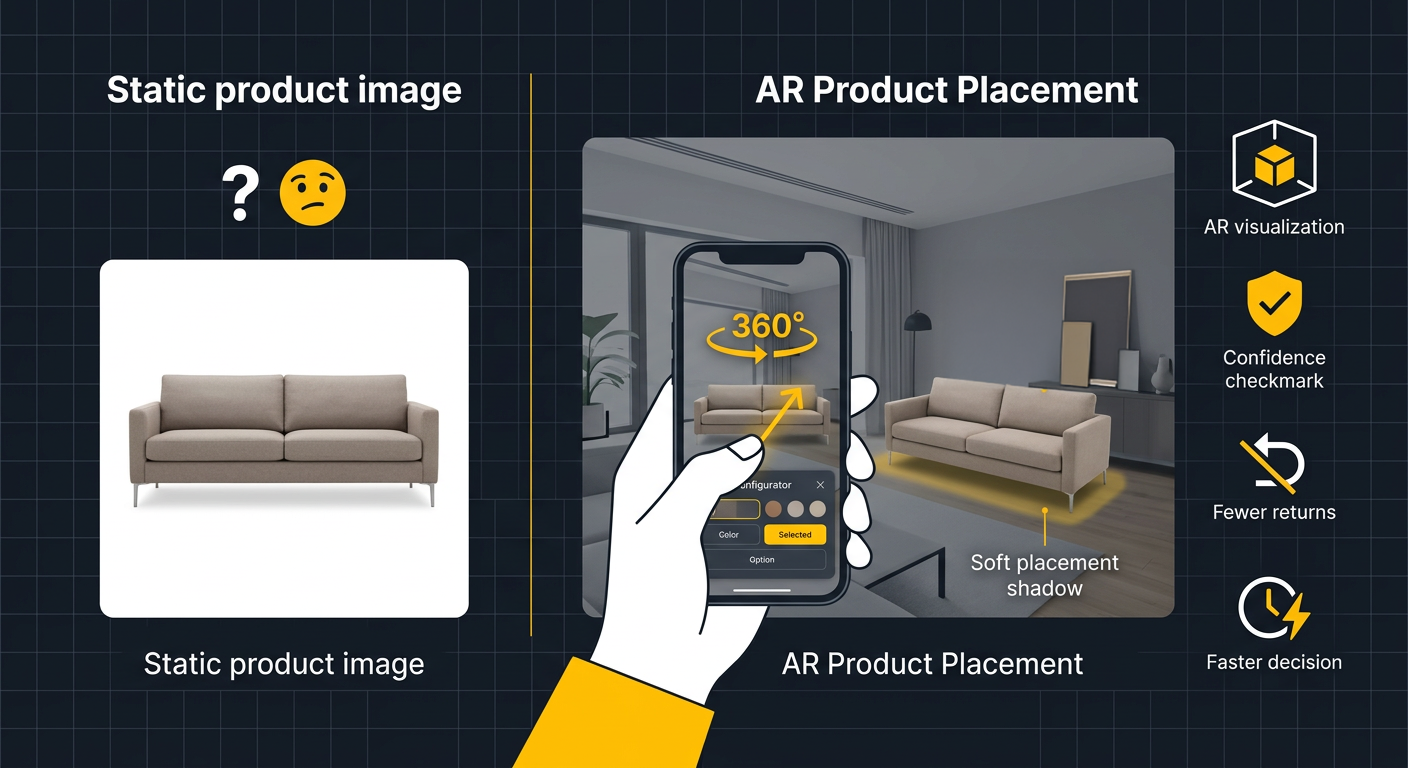
WebAR is the most accessible approach. It runs directly in the mobile browser — no app download required. A customer taps a "View in your space" button, grants camera access, and sees a 3D model of the product overlaid on their real environment. This matters because studies show nearly 80% of people drop off when asked to download an app first. WebAR sidesteps that friction entirely. Browser support for the underlying WebXR API has reached critical mass — Chrome, Edge, Firefox, and Safari all support it as of late 2025, closing what was previously a major gap.
Native AR (through iOS ARKit and Android ARCore) offers higher fidelity. Apps like IKEA Place pioneered this approach, letting customers place true-to-scale furniture in their rooms with 98% dimensional accuracy. The tradeoff is that you need users to install a dedicated app, which limits reach.
Try-before-you-buy AR is a category unto itself, used heavily in eyewear, cosmetics, and jewelry. Customers see the product on themselves via front-facing camera — think virtual ring try-on or lipstick shade matching. When done well, these experiences drive significant results: Shopify merchants report that visitors are 65% more likely to place an order after interacting with a product in AR, and products with AR content see conversion rates 94% higher than those without.
Real-World Examples That Prove the Model
The companies seeing real returns from AR are not experimenting — they have deployed it at scale with measurable outcomes.
IKEA Place remains the most well-known example. With over 2,000 products available in AR and millions of downloads since its 2017 launch, IKEA demonstrated that customers who visualize furniture in their own space convert at meaningfully higher rates than those who do not. The app's success helped push the entire furniture industry toward AR adoption.
Home Depot reported 35% fewer product returns after implementing 3D and AR visualization, with AR users converting at two to three times the rate of non-AR users. When you sell products that need to fit a specific space — kitchen cabinets, bathroom vanities, flooring — letting customers verify dimensions in their own home before purchasing is not a gimmick. It is a direct reduction in costly returns.
Rebecca Minkoff found that shoppers were 44% more likely to add an item to their cart after interacting with it in 3D, and 27% more likely to complete the purchase. These are not marginal improvements — they represent fundamental shifts in how customers engage with products online.
VR Showrooms: Impressive but Niche
Full virtual reality shopping — putting on a headset and browsing a virtual store — is technically possible but far from mainstream. Meta shipped approximately 1.7 million Quest units in the first three quarters of 2025, and Apple's Vision Pro, despite its technical brilliance, saw shipments decline year-over-year as the $3,499 price tag kept it firmly in early-adopter territory. The overall VR headset market actually contracted by 42.8% in 2025.
That said, VR showrooms have genuine utility in specific scenarios: high-value configurable products like luxury kitchens, automotive interiors, or architectural spaces where customers benefit from feeling immersed in the environment. A customer configuring a $50,000 kitchen renovation may find genuine value in "standing" inside their future kitchen through a VR headset. But for the vast majority of ecommerce products, VR adds complexity without proportional value.
The more interesting development is the shift toward smart glasses. The market for display-equipped smart glasses grew 211% in 2025, and both Apple and Meta are prioritizing lightweight AR glasses over bulky headsets. When AR glasses reach consumer-friendly price points, the shopping experience could shift dramatically — but that is still a few years away.
The Practical Limitations You Need to Know
Before investing in AR or VR for your product configurator, it is important to understand the real constraints.
Device fragmentation remains a challenge. While WebXR browser support has improved substantially, the quality of the AR experience varies widely across devices. A flagship iPhone renders AR beautifully; a budget Android phone from three years ago may struggle with surface detection and tracking. This means the experience is not uniform across your customer base.
3D content creation is expensive. Every product that appears in AR needs a high-quality 3D model with accurate materials, textures, and proportions. For a business with hundreds or thousands of SKUs, building that asset library is a significant investment. This is why the choice between 2D and 3D visualization matters — you need to weigh the conversion benefits against the content production cost.
WebXR is production-ready but not perfect. The arrival of WebGPU alongside WebXR has brought near-native rendering performance to the browser, and hand tracking and spatial audio APIs have matured significantly. But complex configurators with dozens of material options and parametric geometry still push the limits of what browsers handle smoothly on mid-range devices.
Customer readiness varies by category. The psychology of customization tells us that customers value products they help design — but not all customers are ready to interact with AR. In furniture and home decor, AR adoption is strong because the use case is intuitive ("will this couch fit in my living room?"). In categories like apparel or industrial components, the value proposition is less obvious and adoption is lower.
3D Configurators: The Foundation That Makes AR and VR Possible
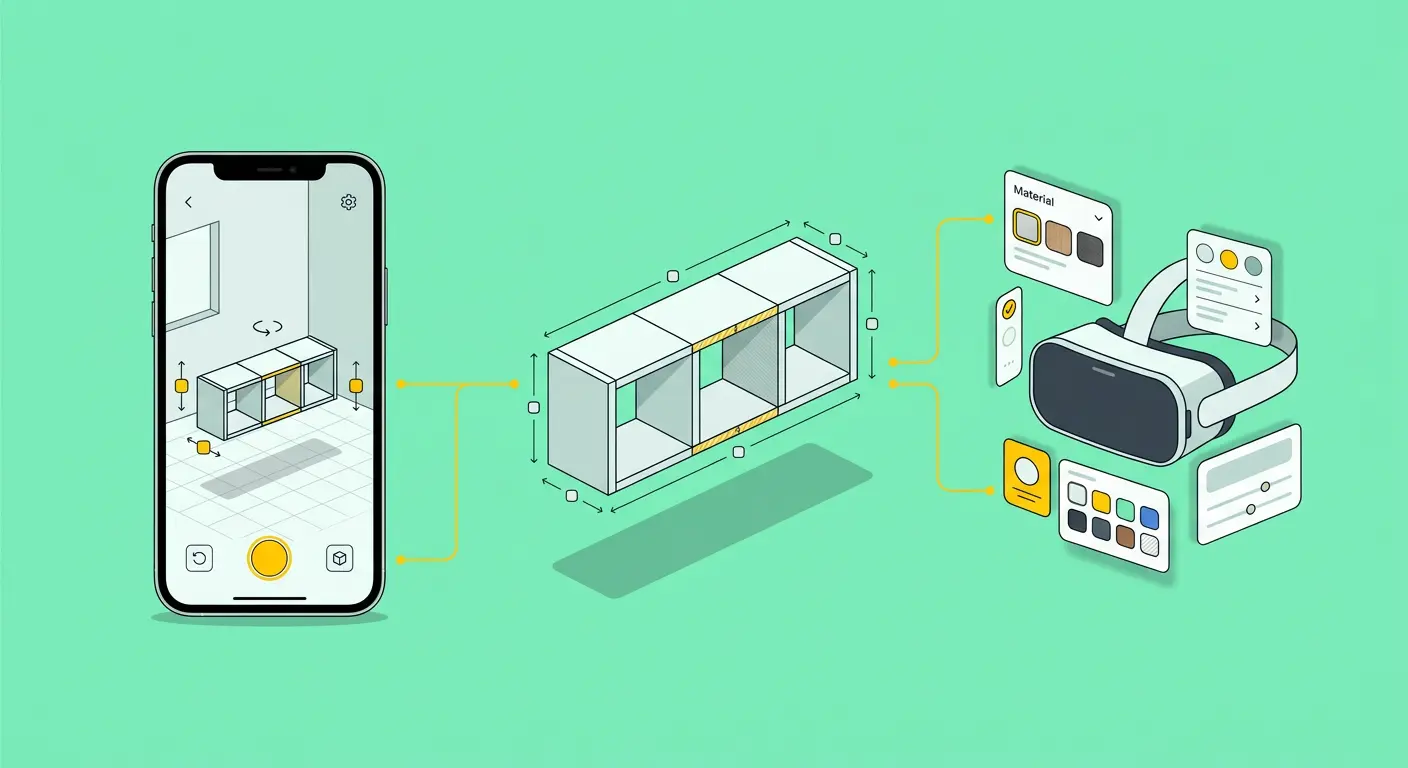
Here is what many businesses miss: you cannot do AR or VR without first having high-quality 3D product models. A 3D product configurator is not just a visualization tool — it is the foundation layer that makes every immersive experience possible. The same 3D model that powers your interactive configurator on the web can be projected into a customer's living room via AR or loaded into a VR showroom.
This means that investing in a 3D configurator today is not just about improving your current website experience — it is about building the asset infrastructure that will power AR and VR experiences tomorrow. Every 3D model you create, every material texture you define, every parametric rule you build becomes reusable across channels.
The businesses that will move fastest into AR and VR are the ones that already have their products in 3D. Those still relying on static photography will face a much longer and more expensive transition.
How Configurator.tech Prepares You for AR and VR
At Configurator.tech, every 3D product configurator we build generates models that are AR-ready from day one. The same high-fidelity 3D assets that let your customers rotate, customize, and explore products on your website are structured to work seamlessly with WebAR, native AR frameworks, and emerging VR platforms.
Whether you sell custom furniture, personalized jewelry, or any other configurable product, our prebuilt configurator templates give you a head start. You get the immediate conversion benefits of interactive 3D visualization — Shopify data shows up to 94% higher conversion rates and 40% fewer returns — while simultaneously building the 3D asset library that will power your AR and VR experiences as those channels mature.
The practical path forward is clear: start with a 3D configurator that delivers ROI today, and let that same investment carry you into AR and VR when your customers and your market are ready. If you want to explore what that looks like for your specific products, get in touch with our team — we will show you exactly how your product configurator can evolve alongside these technologies.