
'%3e%3cpath%20d='M15.1003%2043.5001C33.2091%2043.5001%2043.1166%2028.4935%2043.1166%2015.4838C43.1166%2015.062%2043.1072%2014.6307%2043.0884%2014.2088C45.0157%2012.815%2046.679%2011.0886%2048%209.11072C46.205%209.90932%2044.2993%2010.4309%2042.3478%2010.6576C44.4026%209.42594%2045.9411%207.49107%2046.6781%205.21166C44.7451%206.35724%2042.6312%207.16535%2040.4269%207.60134C38.9417%206.02324%2036.978%204.97835%2034.8394%204.62822C32.7008%204.27809%2030.5064%204.64222%2028.5955%205.66431C26.6846%206.68641%2025.1636%208.30953%2024.2677%2010.2827C23.3718%2012.256%2023.1509%2014.4694%2023.6391%2016.5807C19.725%2016.3843%2015.8959%2015.3675%2012.4%2013.5963C8.90405%2011.8251%205.81939%209.339%203.34594%206.29916C2.0888%208.46661%201.70411%2011.0314%202.27006%2013.4723C2.83601%2015.9132%204.31013%2018.047%206.39281%2019.4401C4.82926%2019.3905%203.29995%2018.9695%201.93125%2018.212V18.3338C1.92985%2020.6084%202.7162%2022.8133%204.15662%2024.5737C5.59704%2026.334%207.60265%2027.5412%209.8325%2027.9901C8.38411%2028.3864%206.86396%2028.4441%205.38969%2028.1588C6.01891%2030.115%207.24315%2031.8259%208.89154%2033.0528C10.5399%2034.2797%2012.5302%2034.9613%2014.5847%2035.0026C11.0968%2037.7423%206.78835%2039.2284%202.35313%2039.2213C1.56657%2039.2201%200.780798%2039.1719%200%2039.077C4.50571%2041.9676%209.74706%2043.5029%2015.1003%2043.5001Z'%20fill='%23F7F7F7'/%3e%3c/g%3e%3cdefs%3e%3cclipPath%20id='clip0'%3e%3crect%20width='48'%20height='48'%20fill='white'/%3e%3c/clipPath%3e%3c/defs%3e%3c/svg%3e)


Jewelry is one of the most personal purchases a person can make. Whether it is an engagement ring, a milestone necklace, or a pair of everyday earrings, buyers increasingly want to shape the design themselves rather than settle for something mass-produced. For jewelry brands, the challenge is clear: how do you let customers design one-of-a-kind pieces online, see exactly what they are getting, and keep operations efficient? The answer is a product configurator.
This guide explores why the jewelry industry is uniquely suited to configurator technology, what these tools actually do, and how they translate a customer's creative vision into a finished piece with fewer surprises and fewer returns.
The Custom Jewelry Opportunity
The numbers behind personalized jewelry tell a compelling story. According to Grand View Research, the global jewelry market was valued at approximately $381 billion in 2025 and is projected to reach $578 billion by 2033, growing at a CAGR of 5.5%. Within that broader market, the custom segment is expanding far faster. Research and Markets estimates the customized jewelry market grew from $36.98 billion in 2025 to $42.25 billion in 2026, on track to hit $104.89 billion by 2032 at a compound annual growth rate of 16.06%.
Consumer demand is driving this acceleration. Data from Global Growth Insights shows that more than 65% of consumers now prefer personalized accessories over standardized designs, while roughly 58% of millennial buyers and 62% of Gen Z consumers actively seek customized jewelry options. At the same time, World Metrics reports that online jewelry sales have surged 185% from pre-pandemic levels, with online channels accounting for approximately 25% of global jewelry revenue in 2025. The convergence of customization demand and digital commerce makes this the ideal moment for jewelry brands to invest in interactive design tools.
Why Jewelry Demands a Configurator
Jewelry is among the most complex product categories to sell online. A single ring can involve choices across metal type (gold, platinum, silver, rose gold), gemstone species and cut, setting style, band width, engraving text and font, and precise sizing down to quarter increments. A necklace adds chain length, pendant shape, and clasp type. A bracelet introduces wrist circumference and link configuration. Multiply these variables together and a single product line can generate tens of thousands of unique combinations, far too many to photograph individually.
Traditional ecommerce approaches fall short here. Static product images paired with dropdown menus force customers to imagine how their selections will look together. They cannot see how a pavé setting renders differently in white gold versus rose gold, or how a particular engraving font looks against a polished versus matte finish. This gap between expectation and reality is the leading cause of dissatisfaction. As explored in our guide on the psychology of customization, customers who actively participate in designing a product form a stronger emotional attachment to it, but only if they can actually see the result before committing.
What a Jewelry Configurator Does
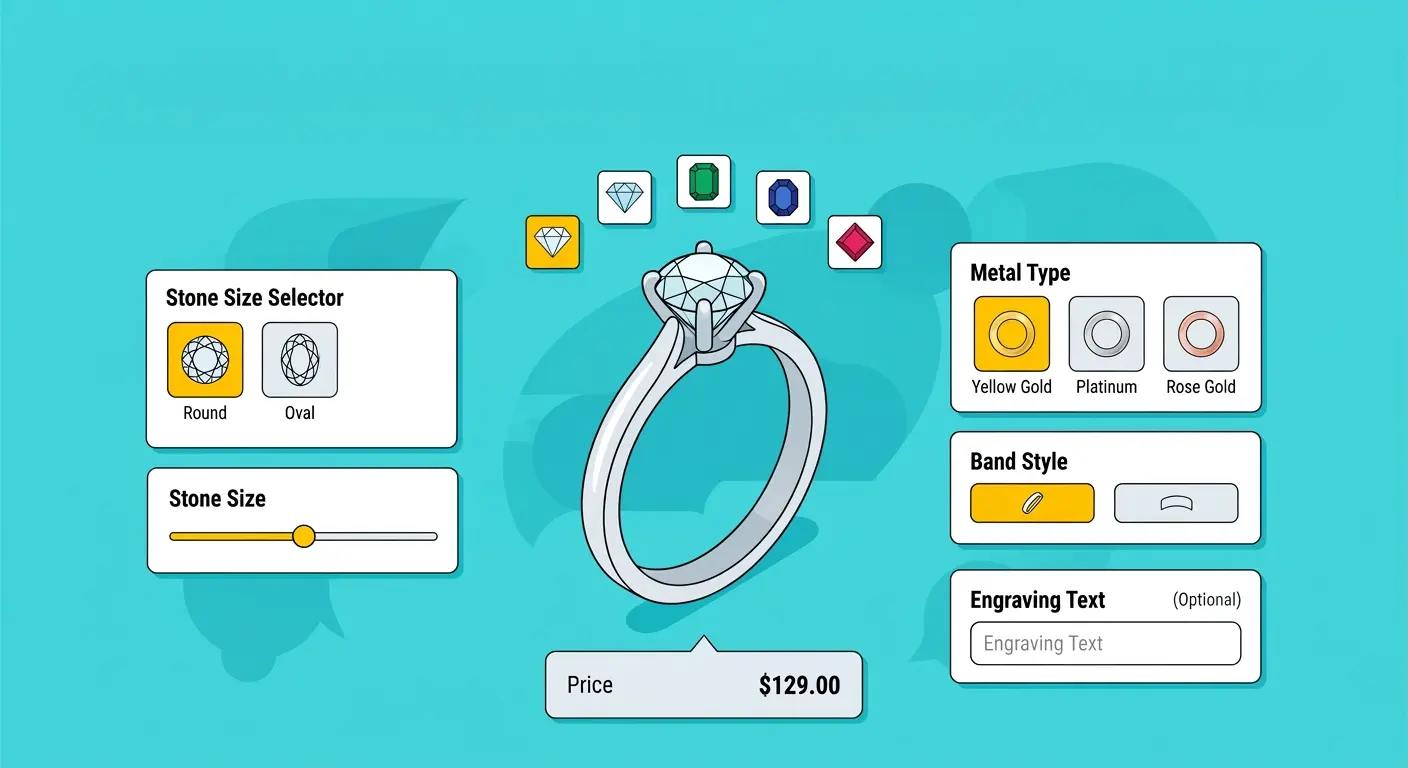
A jewelry configurator is a real-time 3D design tool embedded directly in a brand's storefront. It replaces static imagery with an interactive, photorealistic model that the customer manipulates on the fly. For a deeper explanation of the underlying technology, see our complete guide to product configurators. Here is what a jewelry-specific configurator handles:
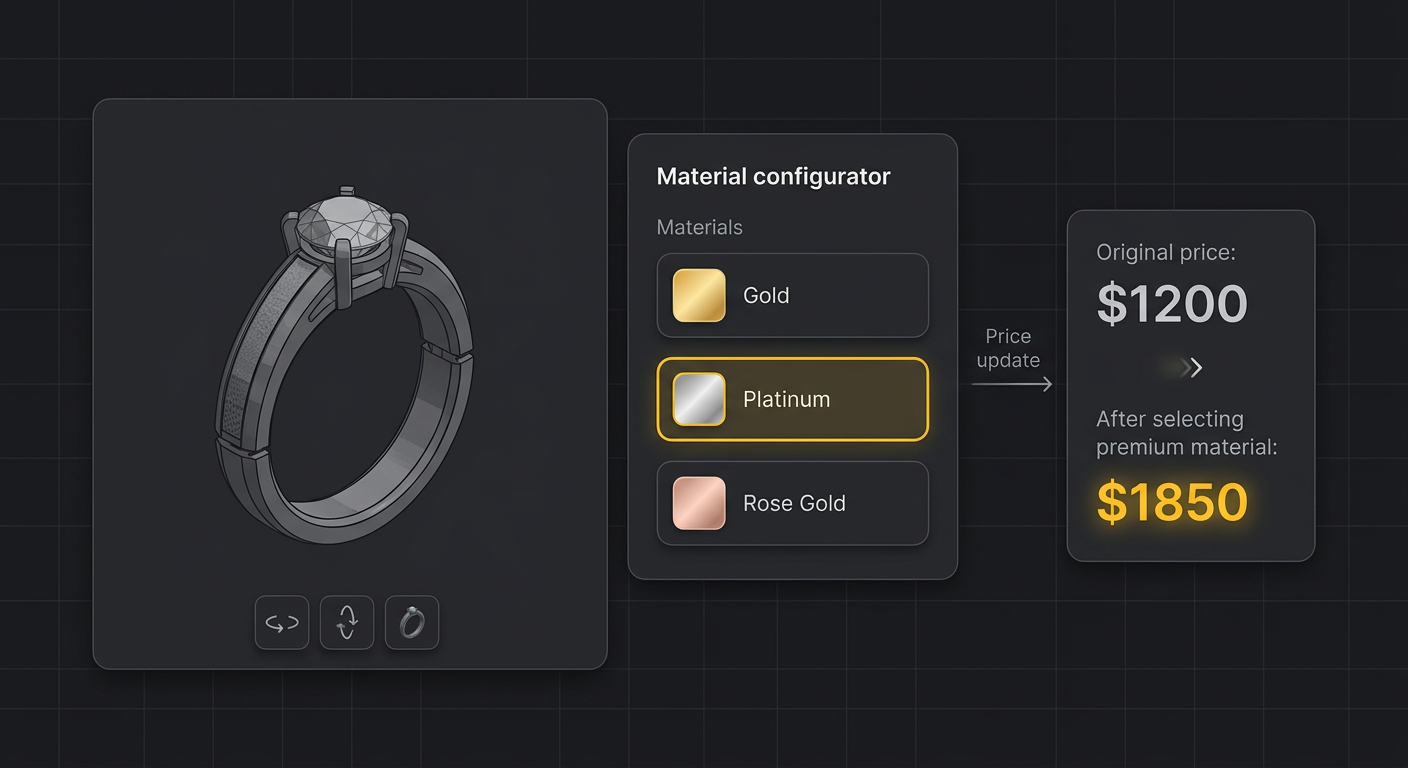
- Material swapping: Toggle between metals such as 14K yellow gold, 18K white gold, platinum, and sterling silver. The 3D model updates reflections, colour temperature, and surface texture in real time.
- Gemstone selection: Choose stone type (diamond, sapphire, emerald, ruby, moissanite), cut (round, oval, princess, cushion), carat weight, and quality grade. The configurator renders accurate light refraction and sparkle for each combination.
- Engraving preview: Type a message, select a font, and see the engraving appear on the interior of a ring band or the back of a pendant instantly.
- Ring sizing: Select a size and watch the band proportions adjust correctly, ensuring the design looks accurate at every size from 4 to 13.
- Live pricing: As each material, stone, and feature is changed, the total price updates instantly, allowing customers to balance design ambitions against their budget without waiting for a manual quote.
Built-in rules prevent invalid configurations. A customer cannot pair a setting that requires a minimum 1-carat stone with a 0.5-carat selection, or choose an engraving length that exceeds the available band surface. This guided experience ensures every order is manufacturable from the start.
How Configurators Reduce Jewelry Returns
Returns are a persistent cost centre in jewelry ecommerce. Digital Commerce 360 reports an average online jewelry return rate of approximately 8%, and while that is lower than the overall ecommerce average of 16.9%, each jewelry return is disproportionately expensive due to high unit values, inspection requirements, and potential damage during shipping.
3D visualization directly attacks the root cause. According to ColorWhistle, jewelry stores using 3D product views see 17% higher conversion rates, while shoppers who interact with a 3D jewelry model are 40% more likely to purchase compared to those viewing standard images. PostIndustria notes that AR and 3D technologies have helped jewelry merchants cut returns by up to 40%, as customers gain accurate expectations of size, proportion, and material appearance before checkout. When a buyer has rotated the ring in 3D, zoomed into the gemstone facets, and previewed their engraving, the likelihood that the delivered piece "looks different than expected" drops sharply. For more strategies on this topic, read our guide on reducing returns on personalized products.
Building Trust Through Visualization
Jewelry carries significant emotional and financial weight. Customers need to trust that the piece they design online will match what arrives in the box. A configurator creates that trust by making the design process transparent. Every choice the customer makes is rendered in front of them in photorealistic detail. There is no ambiguity, no guesswork, and no need to rely on a sales representative's description.
This transparency also supports higher average order values. When customers can see the visual difference between a 0.75-carat and a 1-carat stone, or between a plain band and a diamond-accented one, they make informed upgrade decisions rather than defaulting to the cheapest option. Research from ConfigureID shows that brands using 3D visualization see a 20 to 30 percent lift in average order value. For a broader look at how visual confidence drives sales, explore our article on product visualization and customer trust.
How Configurator.tech Serves Jewelry Brands
Configurator.tech provides cloud-native, parametric 3D configurators purpose-built for industries like jewelry. Our jewelry industry solution includes:
- Prebuilt jewelry templates: The BeeGraphy marketplace offers ready-made configurator templates for rings, necklaces, bracelets, earrings, and pendants. Each template is fully parametric, so dimensions, materials, and gemstone options can be tailored to your product line without building from scratch.
- No-code/low-code setup: Your design team defines rules, constraints, and pricing logic through a visual editor. No 3D programming expertise is required to launch or update configurations.
- Accurate material rendering: PBR (physically based rendering) ensures metals reflect light correctly and gemstones display realistic brilliance, giving customers confidence in their design choices.
- Real-time pricing engine: Material cost, gemstone pricing, labour, and margin calculations update live as the customer designs, so every configuration generates an accurate quote at checkout.
- Production-ready output: Each completed design generates manufacturing data, including CAD-compatible files, material specifications, and engraving instructions, that flows directly to your workshop or casting partner.
Whether you specialise in fine diamond jewelry, fashion pieces, or bespoke wedding bands, the platform adapts to your production workflow. View pricing details or get in touch to discuss your specific requirements.
Getting Started
Launching a jewelry configurator does not require months of custom development. The fastest path is to start from an existing template in the configurator library:
- Choose a template that matches your product category, such as a parametric engagement ring, solitaire pendant, or tennis bracelet.
- Customise the template with your brand's metal options, gemstone inventory, sizing rules, engraving capabilities, and pricing formulas using the visual editor.
- Embed the configurator on your Shopify, WooCommerce, or custom storefront with a single code snippet.
- Connect production by mapping configurator outputs to your jeweler's CAD workflow or casting partner's specifications.
From there, iterate. Track which configurations customers explore most, refine your option sets based on real demand, and expand into new product lines, all without rebuilding the underlying technology.
The custom jewelry market is growing at more than three times the rate of the broader jewelry industry. Customers expect to design their pieces in real time and see exactly what they are buying before they commit. Brands that deliver that experience will capture more sales, reduce costly returns, and build deeper loyalty. A product configurator is no longer a luxury for jewelry businesses. It is the bridge between a customer's sketch and a finished showcase piece.
Ready to bring your jewelry catalogue to life? Contact Configurator.tech and start building your first configurator today.