
'%3e%3cpath%20d='M15.1003%2043.5001C33.2091%2043.5001%2043.1166%2028.4935%2043.1166%2015.4838C43.1166%2015.062%2043.1072%2014.6307%2043.0884%2014.2088C45.0157%2012.815%2046.679%2011.0886%2048%209.11072C46.205%209.90932%2044.2993%2010.4309%2042.3478%2010.6576C44.4026%209.42594%2045.9411%207.49107%2046.6781%205.21166C44.7451%206.35724%2042.6312%207.16535%2040.4269%207.60134C38.9417%206.02324%2036.978%204.97835%2034.8394%204.62822C32.7008%204.27809%2030.5064%204.64222%2028.5955%205.66431C26.6846%206.68641%2025.1636%208.30953%2024.2677%2010.2827C23.3718%2012.256%2023.1509%2014.4694%2023.6391%2016.5807C19.725%2016.3843%2015.8959%2015.3675%2012.4%2013.5963C8.90405%2011.8251%205.81939%209.339%203.34594%206.29916C2.0888%208.46661%201.70411%2011.0314%202.27006%2013.4723C2.83601%2015.9132%204.31013%2018.047%206.39281%2019.4401C4.82926%2019.3905%203.29995%2018.9695%201.93125%2018.212V18.3338C1.92985%2020.6084%202.7162%2022.8133%204.15662%2024.5737C5.59704%2026.334%207.60265%2027.5412%209.8325%2027.9901C8.38411%2028.3864%206.86396%2028.4441%205.38969%2028.1588C6.01891%2030.115%207.24315%2031.8259%208.89154%2033.0528C10.5399%2034.2797%2012.5302%2034.9613%2014.5847%2035.0026C11.0968%2037.7423%206.78835%2039.2284%202.35313%2039.2213C1.56657%2039.2201%200.780798%2039.1719%200%2039.077C4.50571%2041.9676%209.74706%2043.5029%2015.1003%2043.5001Z'%20fill='%23F7F7F7'/%3e%3c/g%3e%3cdefs%3e%3cclipPath%20id='clip0'%3e%3crect%20width='48'%20height='48'%20fill='white'/%3e%3c/clipPath%3e%3c/defs%3e%3c/svg%3e)


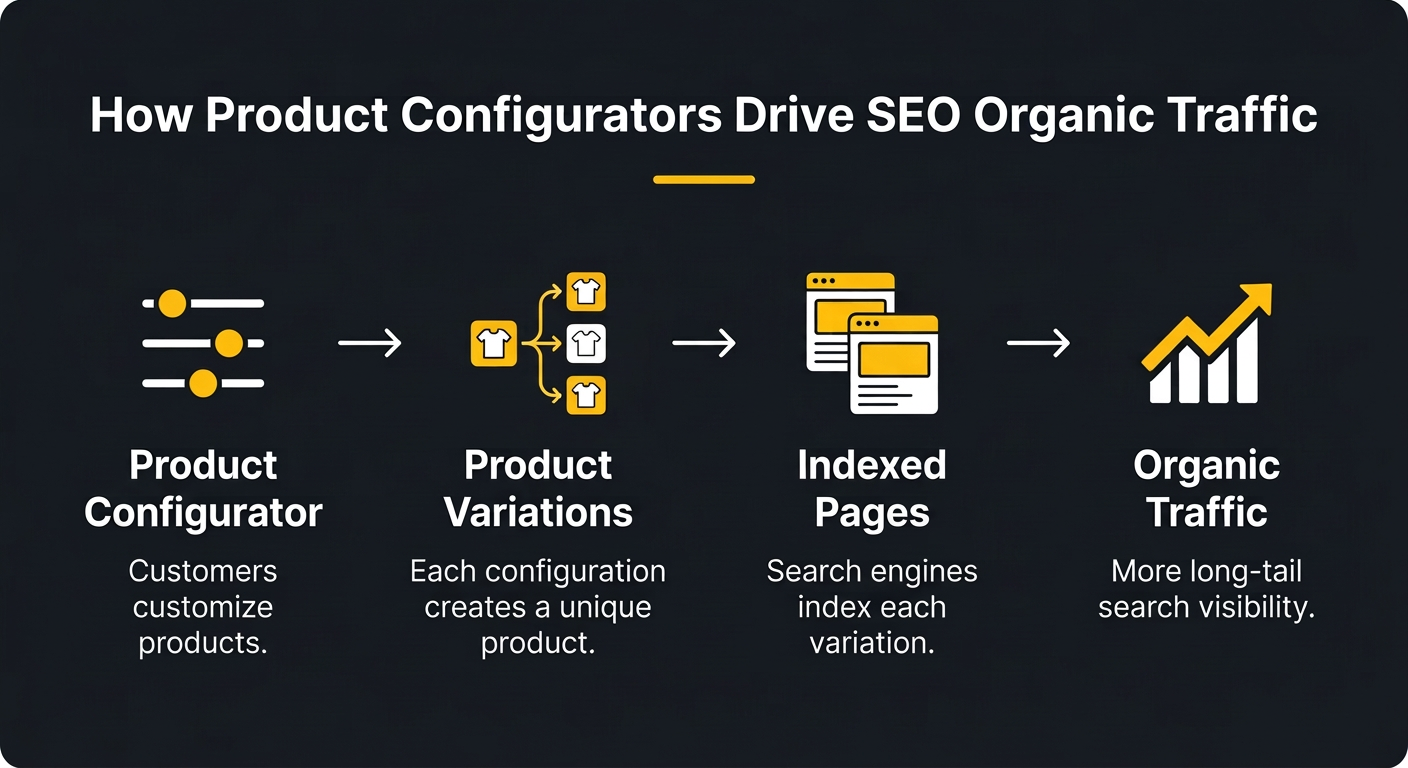
Most ecommerce brands think of product configurators as sales tools — and they are. But configurators also have a profound, often overlooked impact on organic search performance. Every configuration a customer creates is a unique product variation that can be indexed, linked, and ranked. For businesses selling customisable products, a well-implemented configurator is one of the most powerful SEO assets you can deploy.
This article breaks down exactly how product configurators drive organic traffic, backed by data from Google, industry research, and real-world ecommerce performance. If you are still exploring what configurators do at a fundamental level, start with our complete guide to product configurators.
The Long-Tail Keyword Opportunity
Customisable products naturally generate long-tail search queries. A customer searching for a standard product might type "oak dining table." But a customer looking for something specific types "custom oak dining table 180cm walnut legs" — a long-tail query with far less competition and much higher purchase intent. According to Ahrefs research, 92.42% of all keywords get ten or fewer searches per month, and these long-tail terms collectively account for the majority of search traffic.
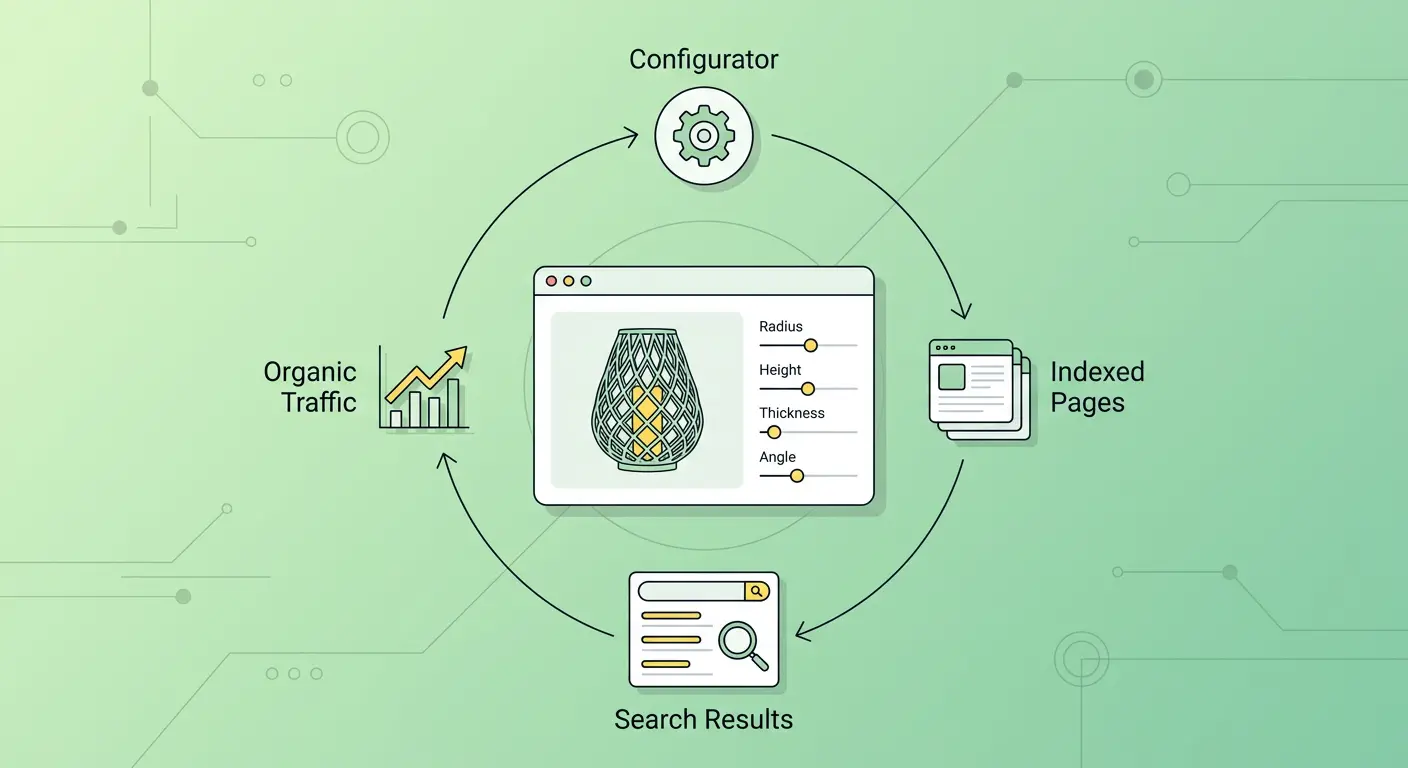
A product configurator creates pages — or page states — that map directly to these long-tail queries. When your configurator generates a unique URL for each configuration (e.g., /configure/dining-table?wood=oak&length=180&legs=walnut), search engines can index those variations as distinct product pages. Each one targets a specific long-tail keyword cluster that your competitors with static catalogues simply cannot reach.
Engagement Metrics That Signal Quality
Google's ranking algorithms increasingly weight user engagement signals. Time on page, scroll depth, interaction rate, and bounce rate all influence how search engines evaluate content quality. Product configurators dramatically improve every one of these metrics.
Shopify's data shows customers spend 2–3x longer on product pages with interactive 3D content compared to static images. That increased dwell time sends a strong signal to search engines that your page satisfies user intent. Configurators also reduce bounce rates because customers engage with the tool rather than clicking back to search results. Lower bounce rates and longer sessions are precisely the behavioural signals that correlate with higher rankings.
Structured Data and Rich Results
Product configurators create opportunities for rich structured data that enhances your search listings. Each configuration can output Product schema markup with specific attributes — material, dimensions, colour, price — that enables rich snippets in search results. Products with rich snippets see significantly higher click-through rates because they display pricing, availability, and ratings directly in the search listing.
Beyond Product schema, configurators support FAQ schema (common questions about customisation options), HowTo schema (configuration guides), and BreadcrumbList schema for improved site navigation signals. This structured data layer helps search engines understand your product catalogue at a granular level, which improves both indexing and ranking for relevant queries.
Content Freshness Signals
Search engines favour content that is regularly updated. Product configurators inherently create freshness signals because new configurations are generated continuously. When customers save and share configurations, those URLs receive visits and engagement — signals that the content is current and relevant. Additionally, as you add new materials, options, or product variants to your configurator, the page content updates automatically without requiring manual content management. This continuous content generation is fundamentally different from static product pages that remain unchanged between manual updates.
Internal Linking Architecture
A well-structured configurator strengthens your site's internal linking architecture. Each product category page links to the configurator. The configurator links to related products, material guides, and inspiration galleries. Completed configurations link back to the product category and to related accessories or complementary products. This interconnected structure distributes page authority across your site and helps search engines discover and index your full product range.
The UX design of your configurator directly impacts SEO as well. A configurator that loads fast, works on mobile, and provides clear navigation signals quality to both users and search engines. Core Web Vitals — Google's page experience metrics — reward pages that deliver smooth, responsive interactions, which is exactly what a well-built configurator provides.
User-Generated Content at Scale
Every customer configuration is a form of user-generated content. When customers save, share, or embed their configurations, they create backlinks and social signals that boost your domain authority. Some brands encourage this by adding "share your design" features that generate unique URLs customers post on social media, forums, and Pinterest boards. Each shared configuration becomes an external link pointing back to your product pages — the most valuable type of off-page SEO signal.
This effect compounds over time. A furniture brand with 10,000 shared configurations has 10,000 unique, linkable product pages — each targeting different keyword combinations and attracting different audience segments. Compare that to a competitor with 50 static product pages, and the SEO advantage becomes overwhelming.
Technical SEO Considerations
To capture the full SEO value of a configurator, technical implementation matters. Ensure that configurator pages are server-side rendered or pre-rendered so search engines can crawl the content. Use canonical tags to prevent duplicate content issues when multiple configurations share similar attributes. Implement dynamic meta titles and descriptions that reflect the specific configuration (e.g., "Custom Oak Dining Table — 180cm, Walnut Legs | YourBrand"). And ensure your sitemap includes key configuration landing pages.
The headless commerce approach to configurator integration gives you maximum control over these technical SEO elements. By decoupling the configurator frontend from your CMS, you can optimise rendering, URL structure, and metadata independently for each platform.
How Configurator.tech Supports SEO
Configurator.tech is built with SEO in mind. Our embeddable configurators support server-side rendering for crawlability, generate clean URL structures for each configuration, and output Product schema markup automatically. The platform integrates with your existing CMS — whether Shopify, WooCommerce, Squarespace, or a headless setup — so your configurator pages inherit your site's domain authority and internal linking structure.
Explore our prebuilt configurator templates to see how interactive 3D product pages can transform your organic search performance, or get in touch to discuss your SEO strategy.