
'%3e%3cpath%20d='M15.1003%2043.5001C33.2091%2043.5001%2043.1166%2028.4935%2043.1166%2015.4838C43.1166%2015.062%2043.1072%2014.6307%2043.0884%2014.2088C45.0157%2012.815%2046.679%2011.0886%2048%209.11072C46.205%209.90932%2044.2993%2010.4309%2042.3478%2010.6576C44.4026%209.42594%2045.9411%207.49107%2046.6781%205.21166C44.7451%206.35724%2042.6312%207.16535%2040.4269%207.60134C38.9417%206.02324%2036.978%204.97835%2034.8394%204.62822C32.7008%204.27809%2030.5064%204.64222%2028.5955%205.66431C26.6846%206.68641%2025.1636%208.30953%2024.2677%2010.2827C23.3718%2012.256%2023.1509%2014.4694%2023.6391%2016.5807C19.725%2016.3843%2015.8959%2015.3675%2012.4%2013.5963C8.90405%2011.8251%205.81939%209.339%203.34594%206.29916C2.0888%208.46661%201.70411%2011.0314%202.27006%2013.4723C2.83601%2015.9132%204.31013%2018.047%206.39281%2019.4401C4.82926%2019.3905%203.29995%2018.9695%201.93125%2018.212V18.3338C1.92985%2020.6084%202.7162%2022.8133%204.15662%2024.5737C5.59704%2026.334%207.60265%2027.5412%209.8325%2027.9901C8.38411%2028.3864%206.86396%2028.4441%205.38969%2028.1588C6.01891%2030.115%207.24315%2031.8259%208.89154%2033.0528C10.5399%2034.2797%2012.5302%2034.9613%2014.5847%2035.0026C11.0968%2037.7423%206.78835%2039.2284%202.35313%2039.2213C1.56657%2039.2201%200.780798%2039.1719%200%2039.077C4.50571%2041.9676%209.74706%2043.5029%2015.1003%2043.5001Z'%20fill='%23F7F7F7'/%3e%3c/g%3e%3cdefs%3e%3cclipPath%20id='clip0'%3e%3crect%20width='48'%20height='48'%20fill='white'/%3e%3c/clipPath%3e%3c/defs%3e%3c/svg%3e)


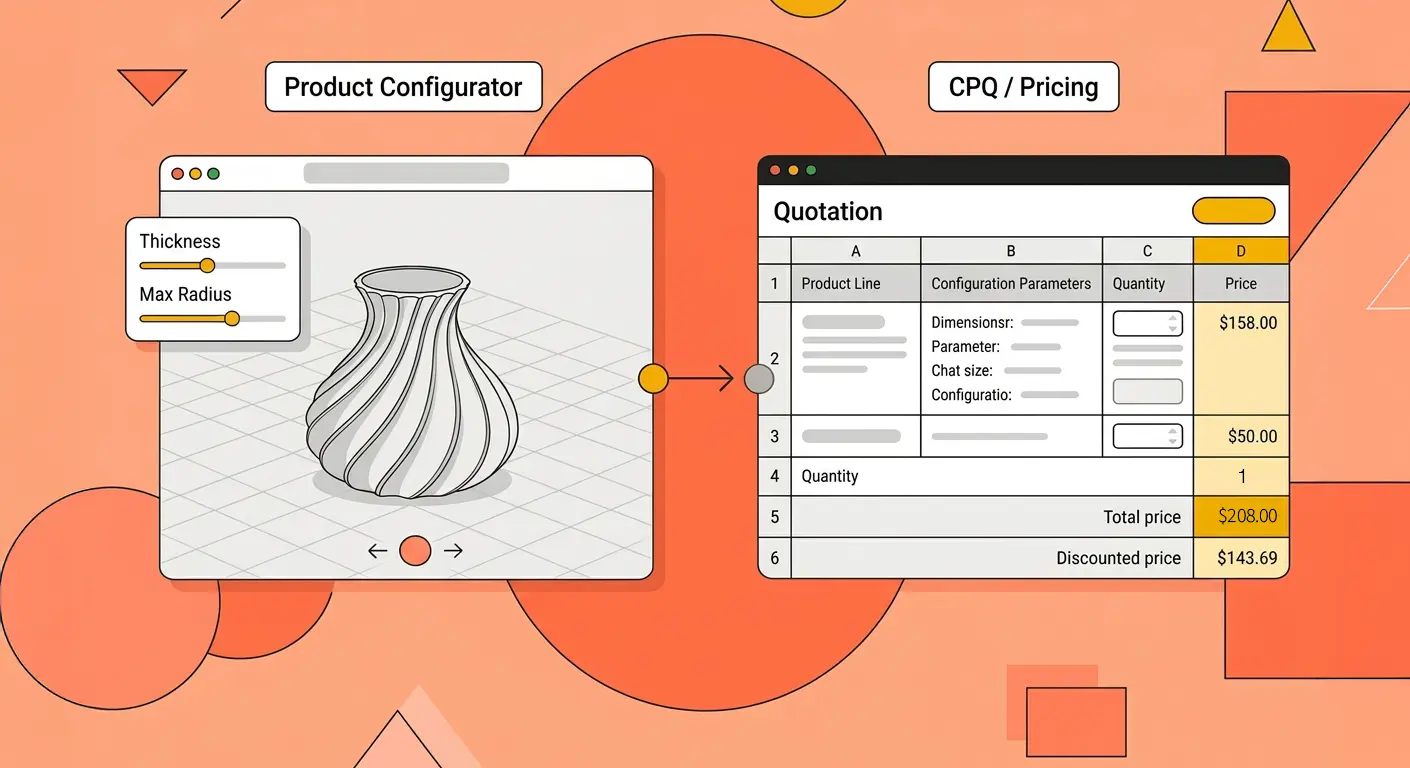
Two terms dominate the conversation around selling configurable products online: product configurator and CPQ (Configure, Price, Quote). Both deal with product customization. Both involve rules and pricing. But they solve fundamentally different problems for different audiences, and choosing the wrong one — or assuming they are interchangeable — can cost you months of implementation time and thousands in wasted spend.
The global CPQ software market was valued at approximately USD 3.49 billion in 2025 and is projected to reach USD 10.84 billion by 2035, growing at a 16.5% CAGR. Meanwhile, the 3D visual product configurator market is on a parallel trajectory, valued at nearly USD 2 billion in 2025 with a 12.9% CAGR through 2032. Both markets are booming — but they serve distinct use cases. Understanding the difference is critical before you invest.
What Is a Product Configurator?
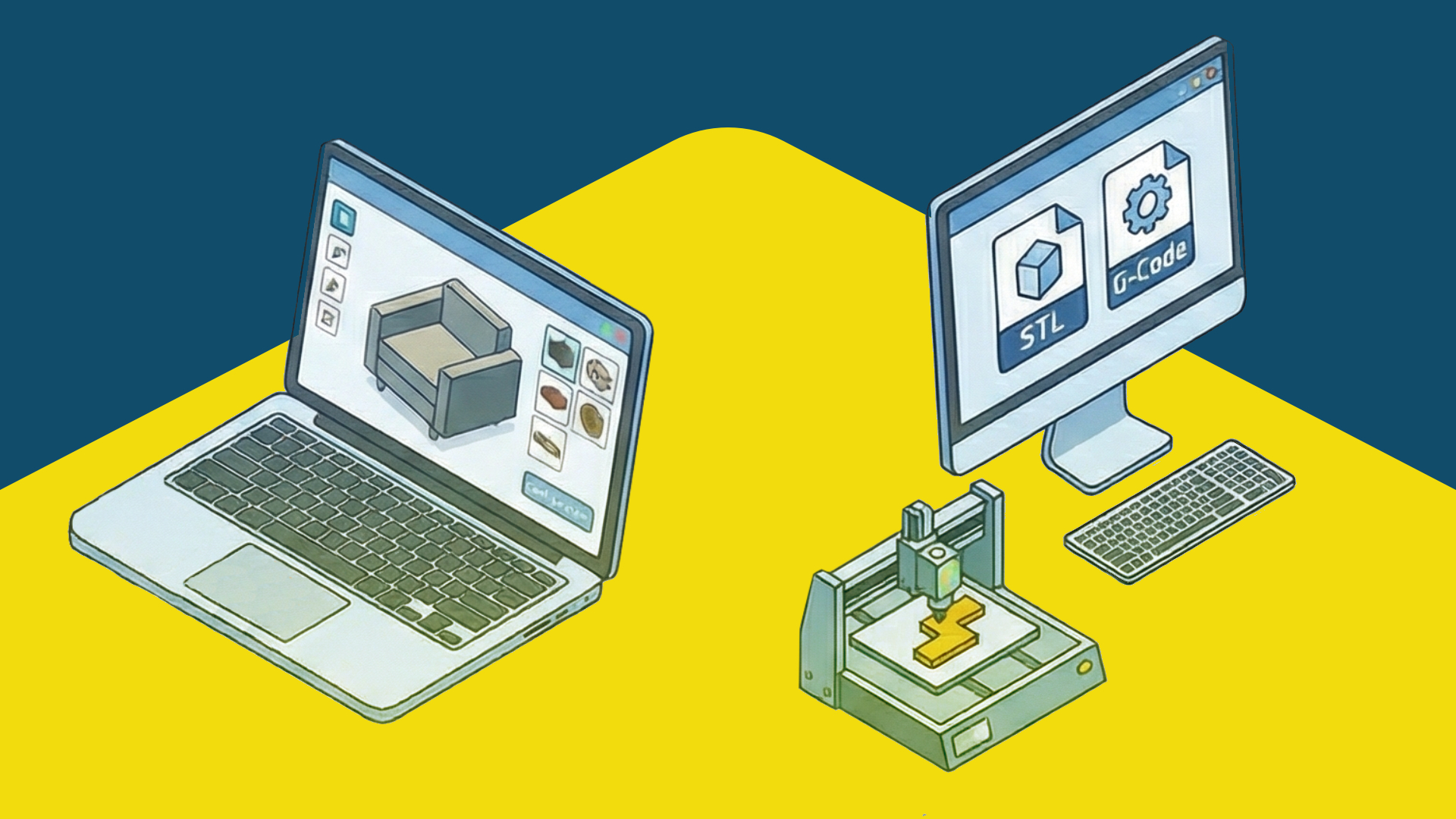
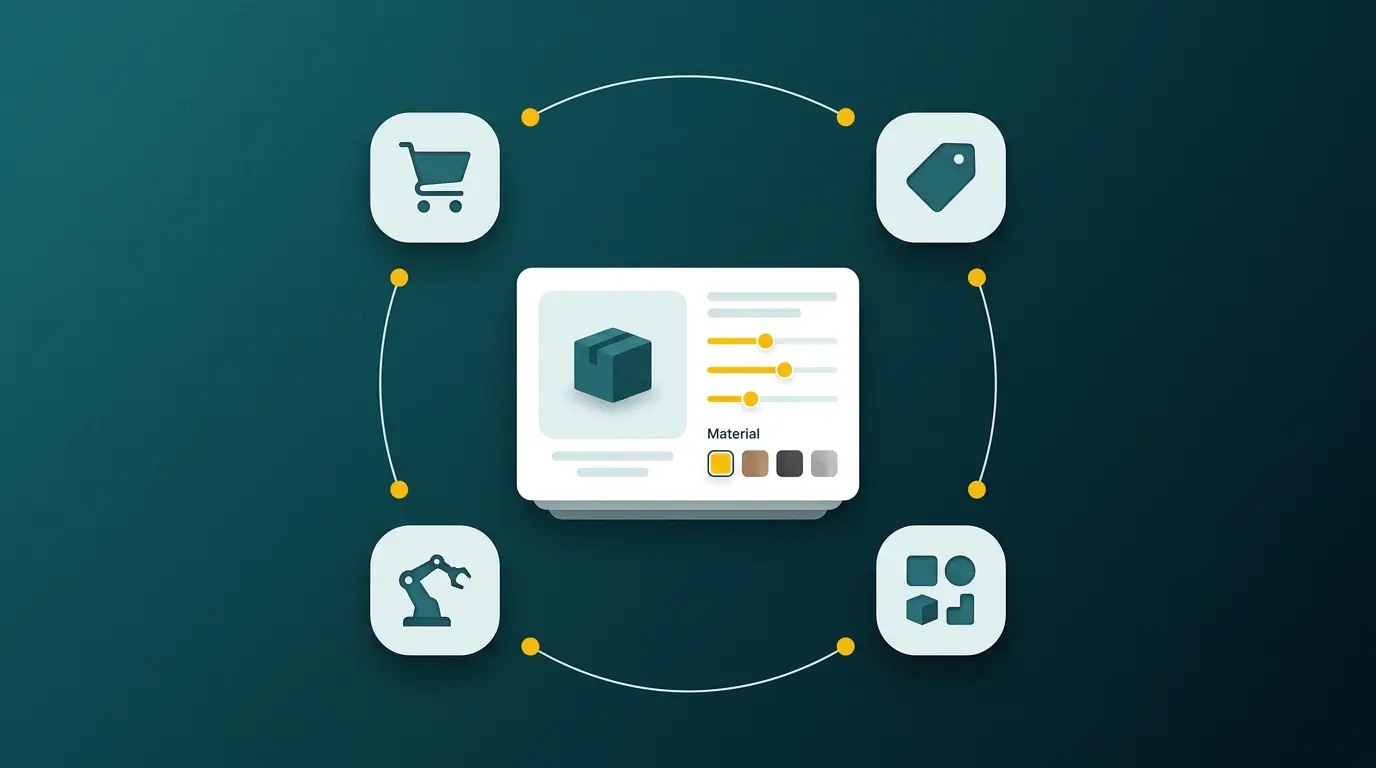
A product configurator is a visual, interactive tool that lets customers design and customize a product themselves. It is customer-facing. The buyer opens the configurator on your website, selects options — material, colour, dimensions, add-ons — and sees the result rendered in real time, typically in 3D. The experience is visual, intuitive, and designed to convert browsers into buyers without requiring any interaction with a sales team.
Product configurators are most common in B2C and direct-to-consumer B2B scenarios: furniture companies letting buyers design custom sofas, manufacturers offering bespoke cabinetry, or jewellery brands allowing customers to build engagement rings stone by stone. The emphasis is on the customer experience — shoppers who view 3D images of products are 11 times more likely to purchase than those who do not. The configurator's job is to eliminate uncertainty, make customization accessible, and drive self-service purchases.
What Is CPQ Software?
CPQ — Configure, Price, Quote — is a sales-team tool. It is designed for internal users, typically sales representatives, who need to assemble complex product configurations, apply the correct pricing rules, and generate formal quote documents for prospects. CPQ software lives inside CRM systems like Salesforce, integrates with ERP platforms, and is built around the sales workflow: configure the product, calculate the price with the right discounts and approvals, and produce a branded PDF quote to send to the buyer.
CPQ is the backbone of enterprise B2B sales. Think industrial equipment manufacturers quoting multi-million-dollar systems, telecom companies bundling service packages, or IT vendors assembling hardware-software-services deals. The interface is typically form-based — dropdown menus, option trees, and approval workflows rather than 3D models and drag-and-drop interactions. According to Salesforce, companies using CPQ generate quotes 10 times faster and see a 95% reduction in approval time. Aberdeen Group research shows CPQ users achieve a 105% increase in average deal size and 28% shorter sales cycles.
Key Differences at a Glance
The core distinction comes down to three dimensions: audience, interface, and output.
Audience. Product configurators are built for end customers — the person buying the product. CPQ is built for sales teams — the people selling it. A configurator sits on your website or in your e-commerce store. CPQ sits inside your CRM or as an internal sales tool.
Interface. Configurators prioritize visual experience. Customers interact with 3D models, rotate products, swap materials, and see photorealistic previews. CPQ prioritizes data accuracy and process compliance. Sales reps work through structured forms, guided selling workflows, and rule-based option trees that prevent invalid configurations.
Output. A configurator's primary output is a customer experience — an engaging, self-service buying journey that ends with an add-to-cart action or an inquiry. CPQ's primary output is a sales document — a formal quote with line items, terms, discounts, and approval signatures that gets sent to a procurement team. Configurators produce production-ready data and manufacturing specs. CPQ produces commercial documents and feeds data into invoicing and contract management systems.
Where They Overlap
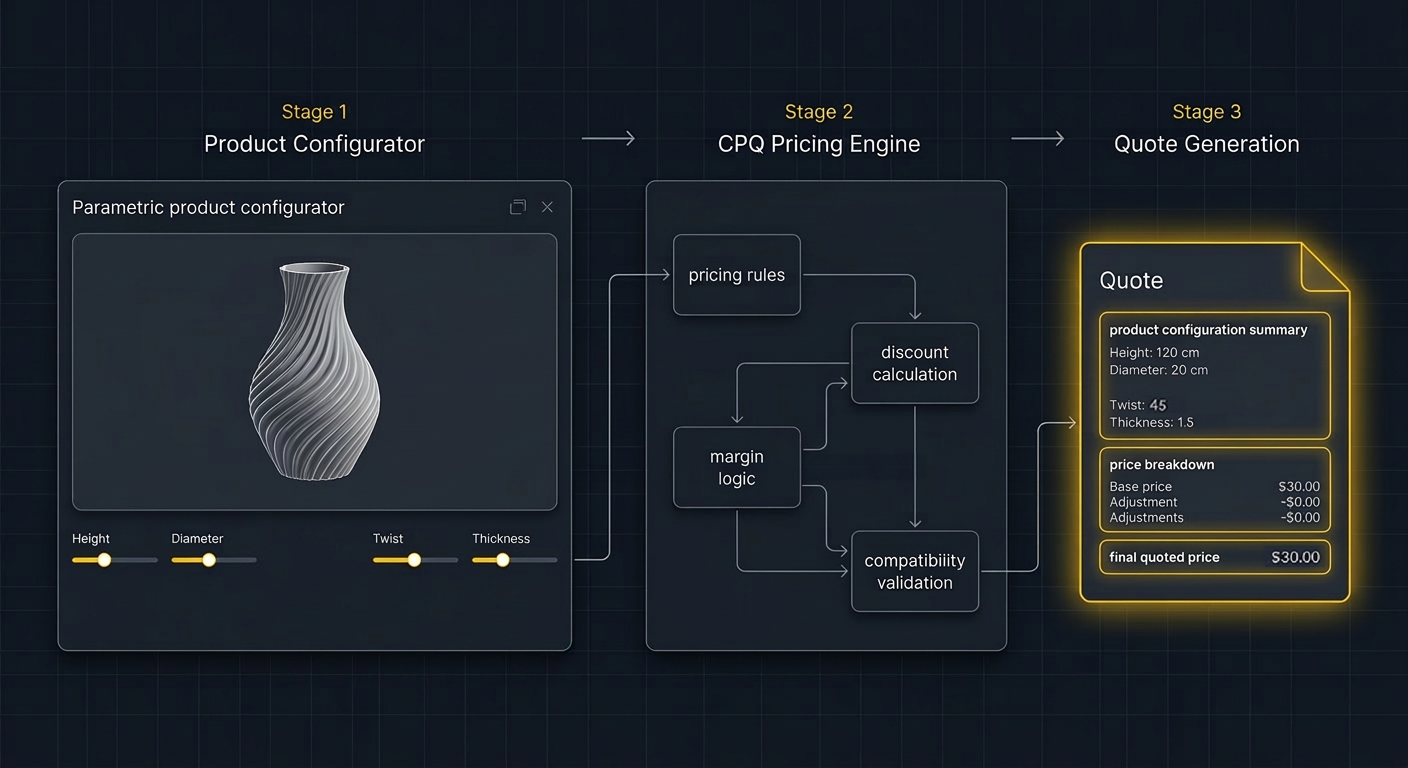
Despite their differences, product configurators and CPQ share significant common ground. Both rely on configuration rules — logic that defines which options are compatible, which combinations are invalid, and which selections trigger dependent changes. Both involve pricing logic: calculating costs based on selected options, applying discounts, and presenting a total. And both aim to reduce errors, whether that is a customer ordering an impossible product combination or a sales rep quoting the wrong price.
The overlap is growing. As real-time pricing becomes standard in product configurators, the line between "configurator" and "CPQ" blurs. A configurator that shows live pricing, applies volume discounts, and generates a downloadable quote is functionally performing CPQ tasks — just with a visual, customer-facing interface instead of a form-based, rep-facing one.
When You Need a Product Configurator
Choose a product configurator when your priority is the customer experience and self-service sales. If your buyers are consumers or small-business purchasers who want to see what they are buying before they commit, a visual configurator is the right tool. Common scenarios include:
- Furniture and interior design companies offering made-to-order products
- Manufacturers selling customizable items directly through their website
- E-commerce brands where product customization is a core differentiator
- Any business where visual confirmation reduces returns and support requests
Explore our prebuilt configurator templates to see how different industries use visual configuration to sell directly to their customers.
When You Need CPQ
Choose CPQ when your sales process is rep-driven and your deals involve complex commercial terms. CPQ is essential when you have multi-tier pricing structures, approval chains, negotiated discounts, and contract-based selling. Typical CPQ use cases include:
- Enterprise software companies bundling licences, support, and services
- Industrial equipment manufacturers with thousands of SKUs and option dependencies
- Businesses where quotes require multiple levels of management approval
- Sales teams that need CRM integration and pipeline visibility on every deal
Gartner projected that over 60% of B2B sales organizations would adopt cloud CPQ by 2026, reflecting how deeply embedded these tools have become in enterprise selling. If your deals involve formal procurement processes and extended sales cycles, CPQ is non-negotiable.
When You Need Both
Many businesses discover they need elements of both. A manufacturer might want a customer-facing 3D configurator on their website for initial product exploration, combined with CPQ capabilities on the back end for generating formal quotes, managing approvals, and feeding order data into their ERP. A B2B company selling configurable industrial products might need the visual engagement of a configurator for trade shows and self-service portals, plus the quoting rigour of CPQ for their inside sales team.
Running two separate systems creates integration headaches, data silos, and inconsistent pricing between what the customer sees online and what the sales rep quotes internally. The ideal solution is a single platform that handles both.
How Configurator.tech Combines Both Worlds
This is exactly the problem Configurator.tech solves. Built on BeeGraphy's engine, the platform delivers the visual, customer-facing experience of a product configurator — interactive 3D models, real-time material swaps, and an intuitive design interface — combined with the pricing, quoting, and production-output capabilities traditionally reserved for CPQ systems.
The calculation panels let you define complex pricing rules without code: material cost tables, dimensional formulas, conditional surcharges, volume discounts, and multi-currency support. Every price updates in real time as the customer interacts with the 3D model. When the configuration is complete, the system can generate formal quote documents, bill-of-materials data, and production-ready manufacturing specs — all from the same configuration session.
For businesses evaluating dedicated CPQ platforms like Epicor CPQ, we have published a detailed comparison between Configurator.tech and Epicor CPQ that breaks down features, pricing, and implementation differences. The short version: traditional CPQ platforms are powerful but complex, often requiring months of implementation and six-figure budgets. Configurator.tech delivers the critical CPQ functions — configure, price, and quote — inside a visual configurator that deploys in days, not months.
The Bottom Line
Product configurators and CPQ software are not competitors — they are complementary tools that address different stages and audiences in the selling process. A configurator excels at customer engagement, visual selling, and self-service commerce. CPQ excels at sales process automation, complex pricing governance, and formal quote generation. The businesses that win are the ones that stop treating these as an either/or decision and find a platform that delivers both capabilities in a single, unified experience.
With CPQ adoption accelerating — organizations using CPQ tools report eliminating 40% of human errors in their quoting processes — and visual configurators becoming table stakes for online selling, the convergence is inevitable. The question is not whether your business needs configuration and pricing automation, but how quickly you can implement it.
Ready to see how a single platform can replace both your configurator and your CPQ? Check our pricing plans or contact our team to discuss your specific requirements. Whether you are selling furniture, industrial equipment, or anything in between, the right configurator eliminates the gap between what your customer sees and what your sales team quotes.