
'%3e%3cpath%20d='M15.1003%2043.5001C33.2091%2043.5001%2043.1166%2028.4935%2043.1166%2015.4838C43.1166%2015.062%2043.1072%2014.6307%2043.0884%2014.2088C45.0157%2012.815%2046.679%2011.0886%2048%209.11072C46.205%209.90932%2044.2993%2010.4309%2042.3478%2010.6576C44.4026%209.42594%2045.9411%207.49107%2046.6781%205.21166C44.7451%206.35724%2042.6312%207.16535%2040.4269%207.60134C38.9417%206.02324%2036.978%204.97835%2034.8394%204.62822C32.7008%204.27809%2030.5064%204.64222%2028.5955%205.66431C26.6846%206.68641%2025.1636%208.30953%2024.2677%2010.2827C23.3718%2012.256%2023.1509%2014.4694%2023.6391%2016.5807C19.725%2016.3843%2015.8959%2015.3675%2012.4%2013.5963C8.90405%2011.8251%205.81939%209.339%203.34594%206.29916C2.0888%208.46661%201.70411%2011.0314%202.27006%2013.4723C2.83601%2015.9132%204.31013%2018.047%206.39281%2019.4401C4.82926%2019.3905%203.29995%2018.9695%201.93125%2018.212V18.3338C1.92985%2020.6084%202.7162%2022.8133%204.15662%2024.5737C5.59704%2026.334%207.60265%2027.5412%209.8325%2027.9901C8.38411%2028.3864%206.86396%2028.4441%205.38969%2028.1588C6.01891%2030.115%207.24315%2031.8259%208.89154%2033.0528C10.5399%2034.2797%2012.5302%2034.9613%2014.5847%2035.0026C11.0968%2037.7423%206.78835%2039.2284%202.35313%2039.2213C1.56657%2039.2201%200.780798%2039.1719%200%2039.077C4.50571%2041.9676%209.74706%2043.5029%2015.1003%2043.5001Z'%20fill='%23F7F7F7'/%3e%3c/g%3e%3cdefs%3e%3cclipPath%20id='clip0'%3e%3crect%20width='48'%20height='48'%20fill='white'/%3e%3c/clipPath%3e%3c/defs%3e%3c/svg%3e)


Doors and windows are among the most highly customised building products in existence. Every opening in a building has unique dimensions, performance requirements, and aesthetic preferences attached to it. Yet much of the fenestration industry still relies on PDF catalogues, phone-based quoting, and manual order entry to sell these products. The result is slow turnaround, frequent errors, and a buying experience that feels decades behind other industries. Product configurators are changing that by letting customers and dealers design, visualise, and order fenestration products in real time through a single digital interface.
This guide explores why doors and windows are uniquely suited to configurator technology, what these tools do under the hood, and how they connect the customer's design intent to the factory floor without manual re-entry.
A Massive Market Moving Online
The global windows and doors market is enormous and still expanding. According to Grand View Research, the market was valued at approximately $275 billion in 2025 and is projected to reach $388 billion by 2033, growing at a compound annual rate of 4.4%. Within that, the energy-efficient segment is accelerating even faster. Coherent Market Insights estimates the global energy-efficient windows market alone will grow from $16.2 billion in 2025 to $25.1 billion by 2032 at a 6.45% CAGR, driven by tightening building codes and rising consumer demand for sustainability.
Despite this scale, digital adoption in fenestration lags behind other building-product categories. Many manufacturers still process orders through spreadsheets and disconnected systems, leaving significant room for error. As the industry grows and projects become more complex, the gap between analogue workflows and modern buyer expectations is becoming a competitive liability.
Why Fenestration Products Are Hard to Sell Online
A single window or door can involve dozens of interrelated variables. Custom sizes measured to the millimetre, glazing types ranging from single-pane to triple-glazed low-emissivity units, frame materials such as aluminium, uPVC, timber, or composite hybrids, hardware choices for handles, hinges, and locking mechanisms, colour and finish options often running into hundreds of RAL codes, and energy performance ratings that must comply with regional building standards. For a deeper explanation of how these tools work across industries, see our complete guide to product configurators.
These variables do not exist in isolation. Choosing a larger frame size may limit the glazing options available. Selecting a particular timber species may restrict the finish palette. Opting for triple glazing changes the weight, which affects the hardware specification. Representing all valid combinations through static product pages is practically impossible. Dropdown menus and PDF spec sheets cannot enforce these interdependencies, so errors creep in at the point of order and are only discovered during manufacturing or, worse, on the building site.
Research from the OrderEase platform shows that manual order-taking across manufacturing sectors produces error rates of 10% or higher. In fenestration specifically, OpenJanela reports that manufacturers adopting specialised digital tools have reduced production errors by over 40% and accelerated quoting by 60%. The National Institute of Standards and Technology (NIST) estimates that human errors in manufacturing lead to scrap and rework costs of 5% to 30% of total production expenses. For custom fenestration, where each unit is made to order and cannot simply be returned to stock, those costs are amplified.
What a Door and Window Configurator Does
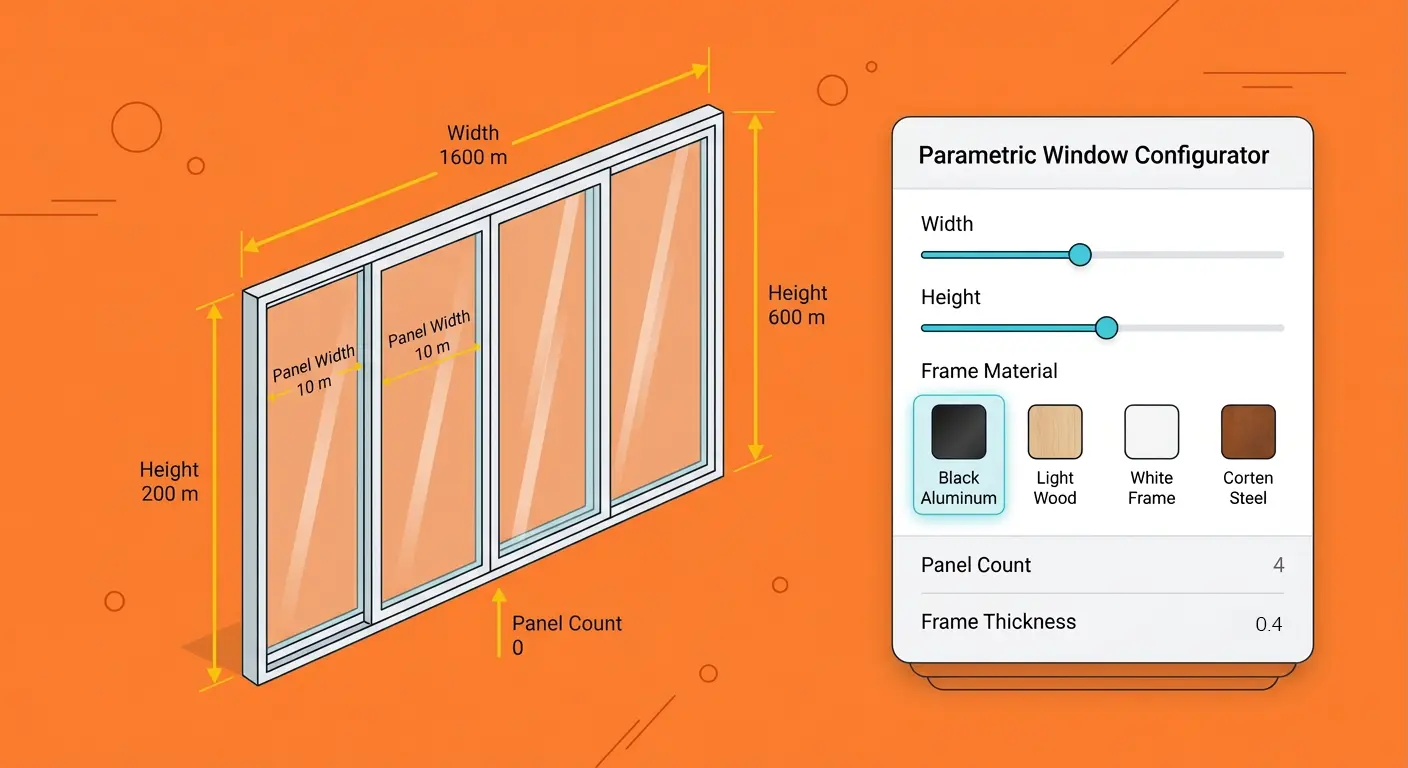
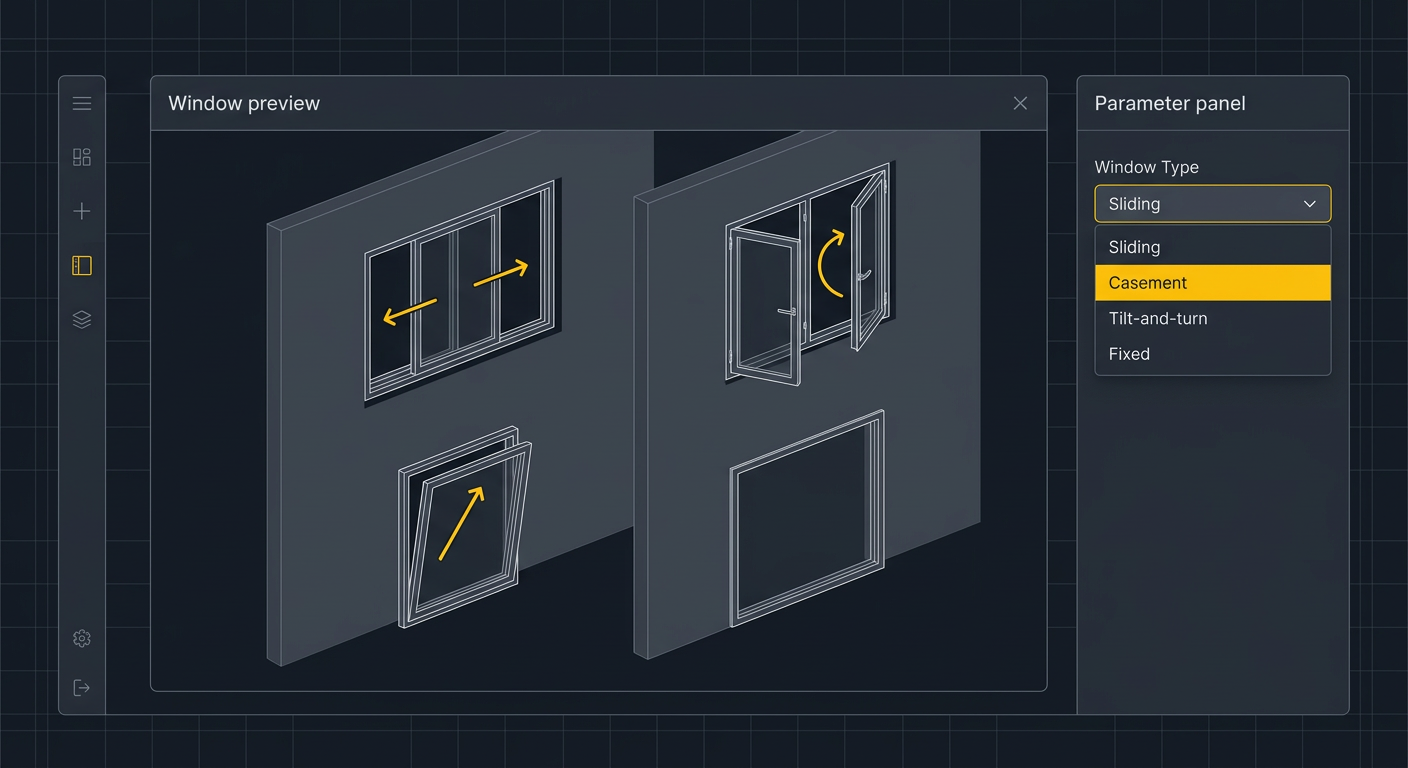
A fenestration configurator replaces static specification workflows with an interactive, rules-driven design environment. The customer or dealer interacts with a 3D model of the product and adjusts it in real time:
- Dimension inputs: Enter exact width, height, and sill depth values. The model updates instantly, and built-in rules flag any measurement outside the manufacturing tolerance range.
- Frame material selection: Switch between aluminium, uPVC, timber, or composite frames and see the visual profile, colour options, and thermal performance values change accordingly.
- Glazing configuration: Choose single, double, or triple glazing, select low-emissivity coatings, argon or krypton gas fills, and decorative patterns. The configurator recalculates U-values and weight automatically.
- Hardware and accessories: Pick handle styles, hinge types, locking systems, trickle vents, and integrated blinds from validated option sets.
- Energy performance preview: As each selection is made, the configurator displays estimated U-values, solar heat gain coefficients, and compliance status against standards like ENERGY STAR or Passive House certification.
- Real-time pricing: Material costs, labour, and margins update live so the buyer can balance specification and budget without waiting for a separate quote. For more on how this works, read our guide to real-time pricing in product configurators.
Because every option is validated against manufacturing rules, the configurator makes it impossible to submit an order that cannot be built. This is the single biggest advantage over traditional quoting workflows, where invalid combinations are caught only after they reach the engineering team.
Reducing Errors in Custom Orders
Order accuracy is the pain point that justifies the investment for most fenestration manufacturers. When a customer specifies a bi-fold door with six panels, a particular threshold detail, and integrated blinds, that specification must travel from the sales channel to the factory without distortion. In a traditional workflow, a salesperson transcribes the requirement into a quoting tool, an engineer validates and converts it into production drawings, and a scheduler sequences it on the shop floor. Each handoff introduces the possibility of transcription errors, misinterpretation, or outdated pricing data.
A configurator collapses these steps. The specification the customer creates is the specification the factory receives. DW-ERP reports that fenestration fabricators using integrated digital workflows have improved quotation turnaround by 70%, reduced stock wastage by 30%, and increased on-time deliveries by 40%. When the order data is born digital and validated at the point of entry, the downstream savings compound across quoting, engineering, production, and delivery.
BOM and Production Data Generation
The true power of a fenestration configurator extends well beyond the customer-facing experience. Underneath the 3D visualisation sits a parametric model, a set of geometric relationships and manufacturing rules that define how every component behaves when dimensions or features change. When an order is finalised, the configurator can automatically generate:
- Bills of materials (BOMs): Itemised lists of every frame section, glazing unit, gasket, hardware piece, and fixing required to manufacture the product.
- Production drawings: DXF, PDF, or SVG outputs with cut lengths, drilling positions, and assembly sequences ready for the CNC or fabrication line.
- Cutting optimisation data: Profile and glass cutting lists that feed directly into optimisation software, minimising material waste.
- Pricing and costing breakdowns: Material cost, labour time, finishing cost, and margin calculations per unit, ensuring every quote reflects actual production economics.
This design-to-fabrication pipeline eliminates the manual translation step where an engineer re-interprets a sales order into shop drawings. The customer's design intent travels intact from browser to factory, reducing lead times and ensuring that what was visualised is exactly what gets built.
How Configurator.tech Serves the Doors and Windows Industry
Configurator.tech is purpose-built for industries where products are highly configurable and production data matters. Our doors and windows industry solution provides manufacturers with cloud-native, parametric 3D configurators that can be embedded directly into dealer portals, ecommerce storefronts, or showroom kiosks. Key capabilities include:
- Prebuilt parametric templates: The BeeGraphy marketplace offers ready-made configurator templates for casement windows, sliding doors, bi-fold systems, entrance doors, and roof windows. Each template is fully parametric, so dimensions, materials, and hardware options can be tailored to your product line without starting from scratch.
- Rule-driven configuration: Define manufacturing constraints, material compatibility rules, and performance thresholds through a visual editor. No 3D programming expertise required.
- Automatic production outputs: Every customer configuration generates BOMs, cutting lists, and production-ready drawings that integrate with your existing ERP, MES, or workshop management system.
- Energy compliance calculations: Built-in thermal performance modelling lets customers see U-values and compliance status in real time as they configure, reducing the back-and-forth with your technical team.
Whether you manufacture aluminium curtain walling or residential uPVC casement windows, the platform adapts to your product complexity and production method. View pricing details or get in touch to discuss your specific requirements.
Getting Started
Deploying a fenestration configurator does not require a year-long software project. The fastest path is to start from an existing template in the configurator library:
- Select a template that matches your product type, such as a parametric casement window or sliding patio door.
- Customise the template with your brand's frame profiles, glazing options, hardware sets, colour palettes, and pricing rules using the visual editor.
- Embed the configurator on your website, dealer portal, or showroom touchscreen with a single code snippet.
- Connect production by mapping configurator outputs to your factory's cutting optimisation software or ERP import format.
From there, you iterate. Track which configurations dealers and homeowners explore most, refine your option sets, add new product lines, and expand into new markets, all without rebuilding the underlying technology.
The fenestration market is growing, energy regulations are tightening, and buyers expect to design and price their products digitally. Manufacturers who offer that experience will win more orders, eliminate costly errors, and compress their quoting-to-production cycle. A product configurator is no longer a nice-to-have for door and window businesses. It is the infrastructure that connects customer intent to factory output.
Ready to digitise your fenestration sales process? Contact Configurator.tech and start building your first door and window configurator today.