

'%3e%3cpath%20d='M15.1003%2043.5001C33.2091%2043.5001%2043.1166%2028.4935%2043.1166%2015.4838C43.1166%2015.062%2043.1072%2014.6307%2043.0884%2014.2088C45.0157%2012.815%2046.679%2011.0886%2048%209.11072C46.205%209.90932%2044.2993%2010.4309%2042.3478%2010.6576C44.4026%209.42594%2045.9411%207.49107%2046.6781%205.21166C44.7451%206.35724%2042.6312%207.16535%2040.4269%207.60134C38.9417%206.02324%2036.978%204.97835%2034.8394%204.62822C32.7008%204.27809%2030.5064%204.64222%2028.5955%205.66431C26.6846%206.68641%2025.1636%208.30953%2024.2677%2010.2827C23.3718%2012.256%2023.1509%2014.4694%2023.6391%2016.5807C19.725%2016.3843%2015.8959%2015.3675%2012.4%2013.5963C8.90405%2011.8251%205.81939%209.339%203.34594%206.29916C2.0888%208.46661%201.70411%2011.0314%202.27006%2013.4723C2.83601%2015.9132%204.31013%2018.047%206.39281%2019.4401C4.82926%2019.3905%203.29995%2018.9695%201.93125%2018.212V18.3338C1.92985%2020.6084%202.7162%2022.8133%204.15662%2024.5737C5.59704%2026.334%207.60265%2027.5412%209.8325%2027.9901C8.38411%2028.3864%206.86396%2028.4441%205.38969%2028.1588C6.01891%2030.115%207.24315%2031.8259%208.89154%2033.0528C10.5399%2034.2797%2012.5302%2034.9613%2014.5847%2035.0026C11.0968%2037.7423%206.78835%2039.2284%202.35313%2039.2213C1.56657%2039.2201%200.780798%2039.1719%200%2039.077C4.50571%2041.9676%209.74706%2043.5029%2015.1003%2043.5001Z'%20fill='%23F7F7F7'/%3e%3c/g%3e%3cdefs%3e%3cclipPath%20id='clip0'%3e%3crect%20width='48'%20height='48'%20fill='white'/%3e%3c/clipPath%3e%3c/defs%3e%3c/svg%3e)



Artificial intelligence is reshaping nearly every corner of ecommerce, and product configurators are no exception. From smart design recommendations that guide customers toward their ideal product to predictive pricing models that optimise margins in real time, AI is adding a layer of intelligence to what were previously static rule-based tools. But separating genuine capability from marketing hype requires a clear-eyed look at what actually works today.
According to McKinsey's State of AI report, 72% of organisations have adopted AI in at least one business function, with product and service development among the top use cases. For product configurators specifically, AI is moving from experimental to practical. This guide covers the real applications, the measurable benefits, and where the technology still has limits. If you are new to configurators, our complete guide covers the fundamentals.
Smart Defaults and Personalised Starting Points
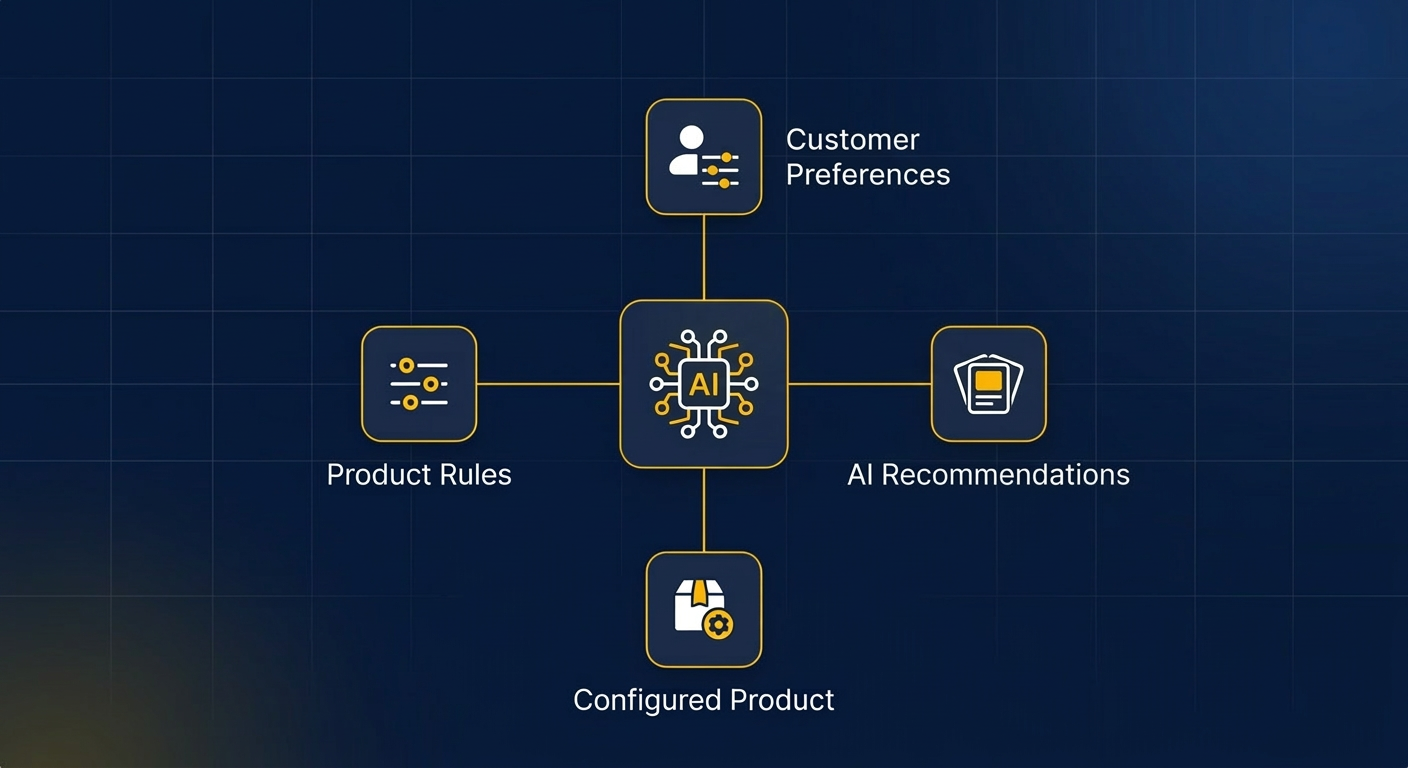
The most immediately impactful AI application in configurators is personalised defaults. Instead of presenting every customer with the same blank canvas, an AI-powered configurator analyses browsing history, geographic data, and aggregate purchase patterns to suggest a starting configuration that matches the customer's likely preferences. A returning customer who previously configured a modern walnut desk sees a modern walnut starting point. A first-time visitor from Scandinavia might see light oak with minimalist hardware.
This matters because configurator abandonment is real. When customers face too many choices with no guidance, many leave without completing a design. Salesforce research shows that 73% of customers expect companies to understand their unique needs and expectations. AI-driven defaults reduce the cognitive load of configuration, turning an overwhelming experience into a guided one. The customer still has full control to change every option — but the starting point feels tailored rather than generic.
Design Recommendations and Guided Configuration
Beyond defaults, AI can actively recommend options as customers configure. When a customer selects a dark walnut frame, the system suggests hardware finishes that other customers have paired most successfully with walnut — brass handles, for instance, rather than chrome. These recommendations are not arbitrary; they are derived from analysis of thousands of completed configurations and purchase data.
The recommendation engine can also flag aesthetic conflicts. If a customer combines materials or proportions that historically lead to higher return rates, the configurator can gently suggest alternatives. This is where the psychology of customisation intersects with AI: customers feel more confident in their choices when a system validates or refines their selections, leading to higher satisfaction and fewer post-purchase regrets.
Predictive Pricing and Dynamic Margins
Traditional configurator pricing engines use fixed rules: material A at dimension B costs X. AI-enhanced pricing adds a dynamic layer. Machine learning models can analyse demand patterns, material cost fluctuations, competitor pricing, and customer willingness-to-pay signals to optimise pricing in real time. A configuration that is in high demand might carry a slight premium, while an underperforming option combination might receive a subtle discount to encourage exploration.
This is not speculative — CPQ platforms with AI-driven pricing have shown measurable results. Gartner reports that organisations using AI in their CPQ processes see 15–25% improvement in quote accuracy and a 10–15% increase in win rates. For configurator-driven businesses, dynamic pricing means better margins without sacrificing conversion rates. Our detailed breakdown of real-time pricing in configurators covers the technical foundations.
Generative Design Integration
Generative design — where AI proposes novel product geometries based on constraints and objectives — is perhaps the most forward-looking application. Instead of customers choosing from predefined options, they specify functional requirements ("a bookshelf that holds 200 books, fits a 2m wall, and uses minimal material") and the AI generates optimised designs that meet those constraints.
Today, generative design in consumer-facing configurators remains limited. The technology works well in industrial applications (Autodesk's generative design tools are used in automotive and aerospace), but translating it to a real-time consumer ecommerce experience requires computational power that is still expensive to deliver at scale. However, hybrid approaches are emerging: AI-generated design suggestions combined with parametric user controls, where the machine proposes and the customer refines. Expect this to become mainstream within the next 2–3 years as cloud GPU costs continue to fall.
Visual Search and Material Matching
Computer vision AI enables customers to upload a photo — of their living room, a Pinterest inspiration image, or an existing product — and the configurator automatically suggests matching materials, colours, and styles. A customer photographs their hardwood floor, and the configurator recommends furniture finishes that complement the wood tone. This reduces the guesswork that leads to "it doesn't match my room" returns, which are among the top reasons for furniture returns.
Material matching also works in reverse: brands can use AI to analyse their material inventory and automatically update configurator options when new materials become available or existing ones go out of stock. This keeps the configurator's offerings current without manual intervention.
Demand Forecasting from Configuration Data
Every customer interaction with a configurator generates data: which options they explore, which they skip, where they spend the most time, and what they ultimately purchase. AI models can analyse this data to forecast demand for specific materials, dimensions, and option combinations before purchase orders are placed. This shifts inventory management from reactive to predictive.
If AI detects a spike in configurations using a particular wood species, the purchasing team can secure material before prices rise. If a new colour option is being explored but rarely purchased, it may indicate a pricing issue rather than a demand issue. These insights turn the configurator from a sales tool into a strategic business intelligence platform. For more on leveraging this data, see our guide to choosing a configurator platform with strong analytics capabilities.
What AI Cannot Replace
Despite the hype, AI does not replace the core value of a product configurator: parametric design logic, constraint validation, and production-ready output. A configurator still needs well-defined rules about what is manufacturable, accurate material properties, and reliable pricing calculations. AI enhances these capabilities but does not substitute for them. A beautifully recommended configuration that cannot be manufactured is worse than no recommendation at all.
The practical path forward is layered: start with a solid parametric configurator that handles your product logic correctly, then add AI features incrementally. Smart defaults first, then recommendations, then predictive pricing. Each layer adds measurable value without requiring you to rebuild the foundation.
Getting Started with AI-Enhanced Configuration
Configurator.tech provides the parametric foundation that makes AI integration possible. Our platform captures the configuration data that feeds AI models, supports API-driven personalisation, and delivers the real-time 3D experience that customers expect. Whether you are starting with a basic configurator or ready to layer on AI-driven recommendations, the platform scales with your ambitions.
Explore our prebuilt configurator templates to see the foundation in action, or contact our team to discuss how AI capabilities can enhance your product configuration experience.