
'%3e%3cpath%20d='M15.1003%2043.5001C33.2091%2043.5001%2043.1166%2028.4935%2043.1166%2015.4838C43.1166%2015.062%2043.1072%2014.6307%2043.0884%2014.2088C45.0157%2012.815%2046.679%2011.0886%2048%209.11072C46.205%209.90932%2044.2993%2010.4309%2042.3478%2010.6576C44.4026%209.42594%2045.9411%207.49107%2046.6781%205.21166C44.7451%206.35724%2042.6312%207.16535%2040.4269%207.60134C38.9417%206.02324%2036.978%204.97835%2034.8394%204.62822C32.7008%204.27809%2030.5064%204.64222%2028.5955%205.66431C26.6846%206.68641%2025.1636%208.30953%2024.2677%2010.2827C23.3718%2012.256%2023.1509%2014.4694%2023.6391%2016.5807C19.725%2016.3843%2015.8959%2015.3675%2012.4%2013.5963C8.90405%2011.8251%205.81939%209.339%203.34594%206.29916C2.0888%208.46661%201.70411%2011.0314%202.27006%2013.4723C2.83601%2015.9132%204.31013%2018.047%206.39281%2019.4401C4.82926%2019.3905%203.29995%2018.9695%201.93125%2018.212V18.3338C1.92985%2020.6084%202.7162%2022.8133%204.15662%2024.5737C5.59704%2026.334%207.60265%2027.5412%209.8325%2027.9901C8.38411%2028.3864%206.86396%2028.4441%205.38969%2028.1588C6.01891%2030.115%207.24315%2031.8259%208.89154%2033.0528C10.5399%2034.2797%2012.5302%2034.9613%2014.5847%2035.0026C11.0968%2037.7423%206.78835%2039.2284%202.35313%2039.2213C1.56657%2039.2201%200.780798%2039.1719%200%2039.077C4.50571%2041.9676%209.74706%2043.5029%2015.1003%2043.5001Z'%20fill='%23F7F7F7'/%3e%3c/g%3e%3cdefs%3e%3cclipPath%20id='clip0'%3e%3crect%20width='48'%20height='48'%20fill='white'/%3e%3c/clipPath%3e%3c/defs%3e%3c/svg%3e)



Every time a customer interacts with your product configurator, they tell you something. Which material they selected first. How long they spent comparing finishes. The exact moment they abandoned the configuration. This behavioural data is a goldmine for product development, pricing strategy, and marketing — yet most businesses leave it untapped.
Traditional ecommerce analytics tracks page views, add-to-cart rates, and conversions. Configurator analytics goes deeper. It captures the decision-making process itself: what customers explore, what they compare, and what ultimately drives their final choice. According to Forrester, insight-driven businesses grow at an average of more than 30% annually, and configurator data is among the richest behavioural datasets a product company can collect.
What Data Configurators Generate
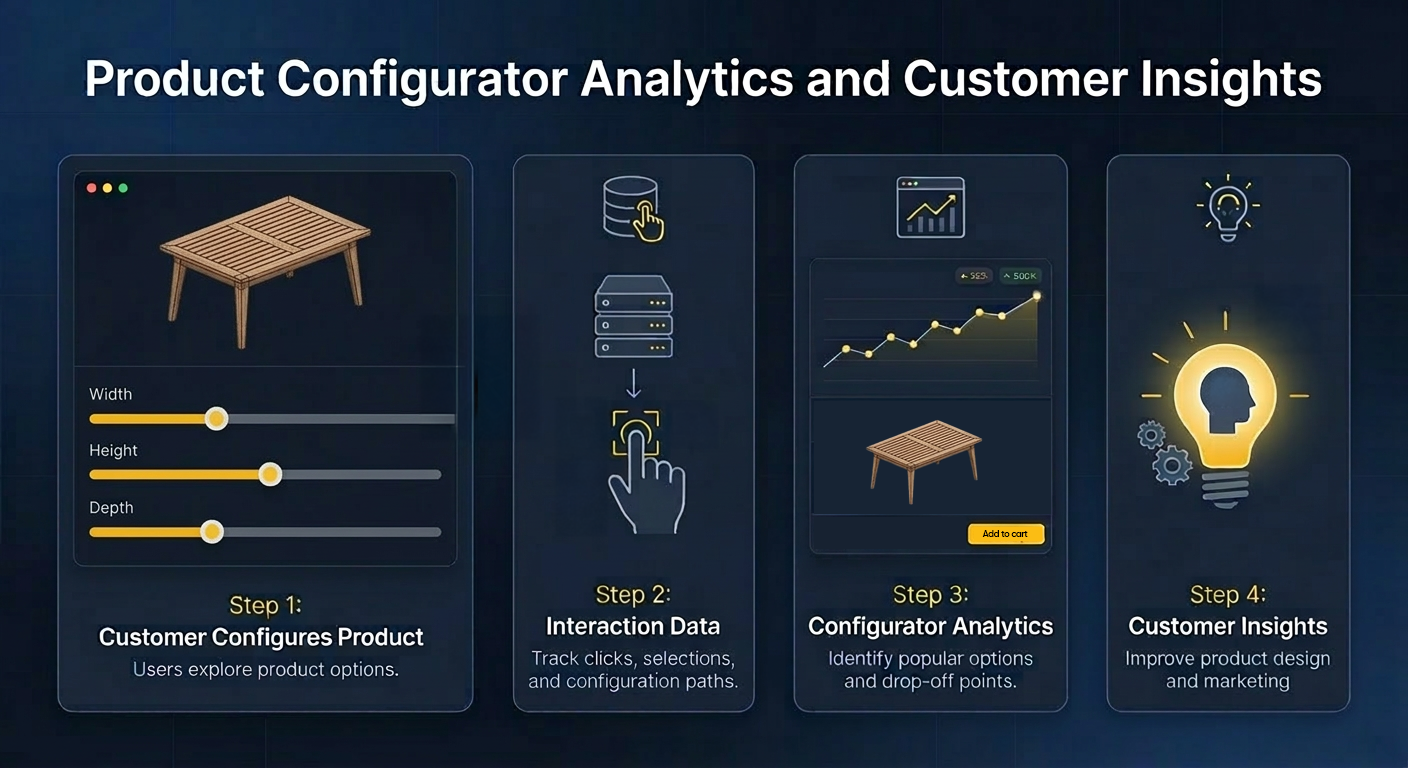
A product configurator captures data at a granularity that no other ecommerce tool matches. At the option level, you see which materials, colours, and features customers select most frequently. At the session level, you see the sequence of choices — did customers pick dimensions first or materials first? At the funnel level, you see exactly where drop-offs occur: did they abandon after seeing the price, after reaching a complex step, or after an option they wanted was unavailable?
Specific data points include: most popular option combinations, average time spent per configuration step, options explored but not selected, price threshold where abandonment spikes, device and geographic breakdowns for configuration behaviour, and completed vs abandoned configuration ratios by product category. This is fundamentally different from standard ecommerce data, which only tells you what customers bought — not what they considered and rejected.
Product Development Insights
Configurator analytics reveals demand for products you have not built yet. If 40% of customers configure a dining table at 200cm but your standard range tops out at 180cm, that data tells you there is unmet demand for a larger size. If customers consistently pair a specific wood with a specific hardware finish, that combination could become a curated "collection" in your catalogue — reducing choice overload while capitalising on proven demand.
Conversely, the data reveals options you can retire. If a material option is explored by fewer than 2% of customers and purchased by fewer than 0.5%, it may not justify its inventory and production costs. Every option in a configurator adds complexity to manufacturing, procurement, and quality control. Analytics helps you prune the options that add cost without driving revenue.
Pricing Optimisation
Configuration data reveals price sensitivity at a per-option level that traditional pricing research cannot match. When you see that customers consistently configure a product up to a specific price point and then start removing options, that price point is a psychological threshold. You can restructure your pricing to keep popular configurations below that threshold — or bundle options to provide perceived value above it.
Baymard Institute reports that 48% of cart abandonments are due to extra costs being too high. Configurator data lets you identify which specific option additions trigger abandonment. Maybe customers happily pay a premium for walnut over oak, but balk at the upcharge for soft-close hinges. This granularity lets you adjust individual option pricing rather than guessing at the product level. The ROI of configurators is amplified when you actively use configuration data to optimise pricing.
Marketing Personalisation
Customers who start but do not finish a configuration have told you exactly what they want. A retargeting email that shows their specific configuration — "You designed a walnut coffee table with brass legs. It's still waiting for you" — is dramatically more effective than a generic product promotion. According to Campaign Monitor, personalised emails deliver 6x higher transaction rates than non-personalised ones.
Beyond retargeting, configurator data segments your audience by preference. Customers who consistently configure minimalist designs with natural materials are a different audience than those who choose bold colours and decorative hardware. These segments can drive targeted ad campaigns, product recommendations, and even landing page personalisation. Understanding the psychology behind customisation choices makes these segments even more actionable.
Connecting to Your Analytics Stack
Configurator analytics delivers the most value when connected to your broader analytics ecosystem. Track configurator events in GA4 as custom events — each option selection, configuration completion, and abandonment becomes a measurable touchpoint. Feed configuration data into your CRM to enrich customer profiles. Connect to your BI dashboard to correlate configuration trends with sales performance, seasonality, and marketing campaigns.
The key is treating configurator interactions as first-class analytics events rather than black-box embeddings. When your sales team can see what a lead configured before a call, they close faster. When your product team can see aggregate configuration trends, they build what customers actually want.
A/B Testing Configurations
Configurator analytics also enables systematic A/B testing of your product offering. Test whether customers prefer a step-by-step wizard or a single-page configurator. Test whether showing the price incrementally ("+$50 for walnut") or as a running total drives higher average order values. Test whether default selections influence final choices. Each test generates clear conversion data because the configurator captures the complete decision journey.
The UX best practices for configurators provide a starting framework, but your specific audience may behave differently. Analytics lets you move from best practices to proven practices for your products and customers.
How Configurator.tech Delivers Analytics
Configurator.tech captures configuration analytics natively. Every customer interaction is tracked, from first click to completed design, with dashboards that surface popular options, abandonment points, and pricing insights. The platform integrates with GA4 via event tracking and exports data to your BI tools via API. Whether you need high-level conversion metrics or granular option-level analysis, the data is there.
Ready to turn customer configuration behaviour into business intelligence? Contact our team to see how configurator analytics can drive your product and pricing strategy.