
'%3e%3cpath%20d='M15.1003%2043.5001C33.2091%2043.5001%2043.1166%2028.4935%2043.1166%2015.4838C43.1166%2015.062%2043.1072%2014.6307%2043.0884%2014.2088C45.0157%2012.815%2046.679%2011.0886%2048%209.11072C46.205%209.90932%2044.2993%2010.4309%2042.3478%2010.6576C44.4026%209.42594%2045.9411%207.49107%2046.6781%205.21166C44.7451%206.35724%2042.6312%207.16535%2040.4269%207.60134C38.9417%206.02324%2036.978%204.97835%2034.8394%204.62822C32.7008%204.27809%2030.5064%204.64222%2028.5955%205.66431C26.6846%206.68641%2025.1636%208.30953%2024.2677%2010.2827C23.3718%2012.256%2023.1509%2014.4694%2023.6391%2016.5807C19.725%2016.3843%2015.8959%2015.3675%2012.4%2013.5963C8.90405%2011.8251%205.81939%209.339%203.34594%206.29916C2.0888%208.46661%201.70411%2011.0314%202.27006%2013.4723C2.83601%2015.9132%204.31013%2018.047%206.39281%2019.4401C4.82926%2019.3905%203.29995%2018.9695%201.93125%2018.212V18.3338C1.92985%2020.6084%202.7162%2022.8133%204.15662%2024.5737C5.59704%2026.334%207.60265%2027.5412%209.8325%2027.9901C8.38411%2028.3864%206.86396%2028.4441%205.38969%2028.1588C6.01891%2030.115%207.24315%2031.8259%208.89154%2033.0528C10.5399%2034.2797%2012.5302%2034.9613%2014.5847%2035.0026C11.0968%2037.7423%206.78835%2039.2284%202.35313%2039.2213C1.56657%2039.2201%200.780798%2039.1719%200%2039.077C4.50571%2041.9676%209.74706%2043.5029%2015.1003%2043.5001Z'%20fill='%23F7F7F7'/%3e%3c/g%3e%3cdefs%3e%3cclipPath%20id='clip0'%3e%3crect%20width='48'%20height='48'%20fill='white'/%3e%3c/clipPath%3e%3c/defs%3e%3c/svg%3e)


Your sales team is busy. But are they busy selling? According to Salesforce's State of Sales report, sales representatives spend only 28% of their week actually selling. The remaining 72% is consumed by administrative tasks, data entry, internal meetings, and — critically — manual quoting. For companies selling configurable or customizable products, that last category is where the biggest efficiency gains hide.
Product configurators don't just help customers visualize what they're buying. They fundamentally reshape how sales teams operate, replacing hours of spreadsheet work with automated, accurate, instant quotes. The result is a sales force that spends less time on paperwork and more time doing what it was hired to do: close deals.
The Manual Quoting Problem
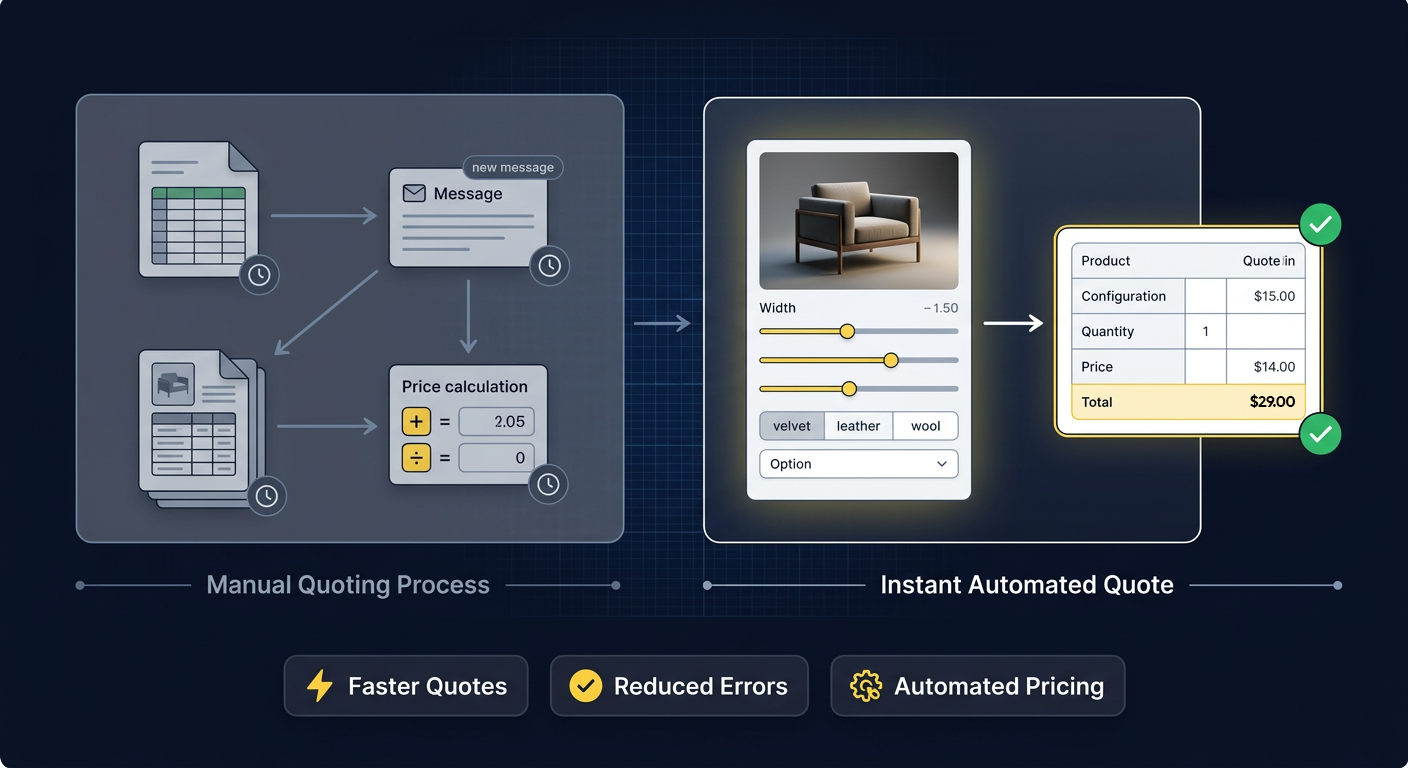
For businesses selling customizable products — furniture, windows, industrial components, jewelry — generating a quote is rarely straightforward. A customer wants a specific material, a non-standard dimension, and a premium finish. The sales rep opens a spreadsheet, cross-references a pricing table, checks inventory availability with the warehouse, calculates shipping based on weight, and emails the quote back. That process takes hours if the rep is experienced. It takes days if they need sign-off from engineering or management.
The data confirms this is pervasive. A survey of 200 B2B manufacturing decision-makers found that manual quoting costs companies an average of 5% of their revenue each year, with 88% of respondents reporting lost deals directly attributable to slow or inaccurate quotes. 71% of respondents said their quotes take at least a full day to produce. Nearly half (48%) said manual quoting prevented them from offering enough pricing flexibility, while 44% cited data-entry errors as a recurring problem.
Those errors are not trivial. A mistyped discount, a miscalculated material cost, or an overlooked surcharge can result in a quote that either undercuts your margin or prices you out of the deal entirely. When CPQ Integrations analyzed the cost of manual quotation, they found that inaccurate quotes erode customer trust, trigger rework cycles, and create downstream production issues that compound across the entire order lifecycle.
How Configurators Automate the Quoting Process
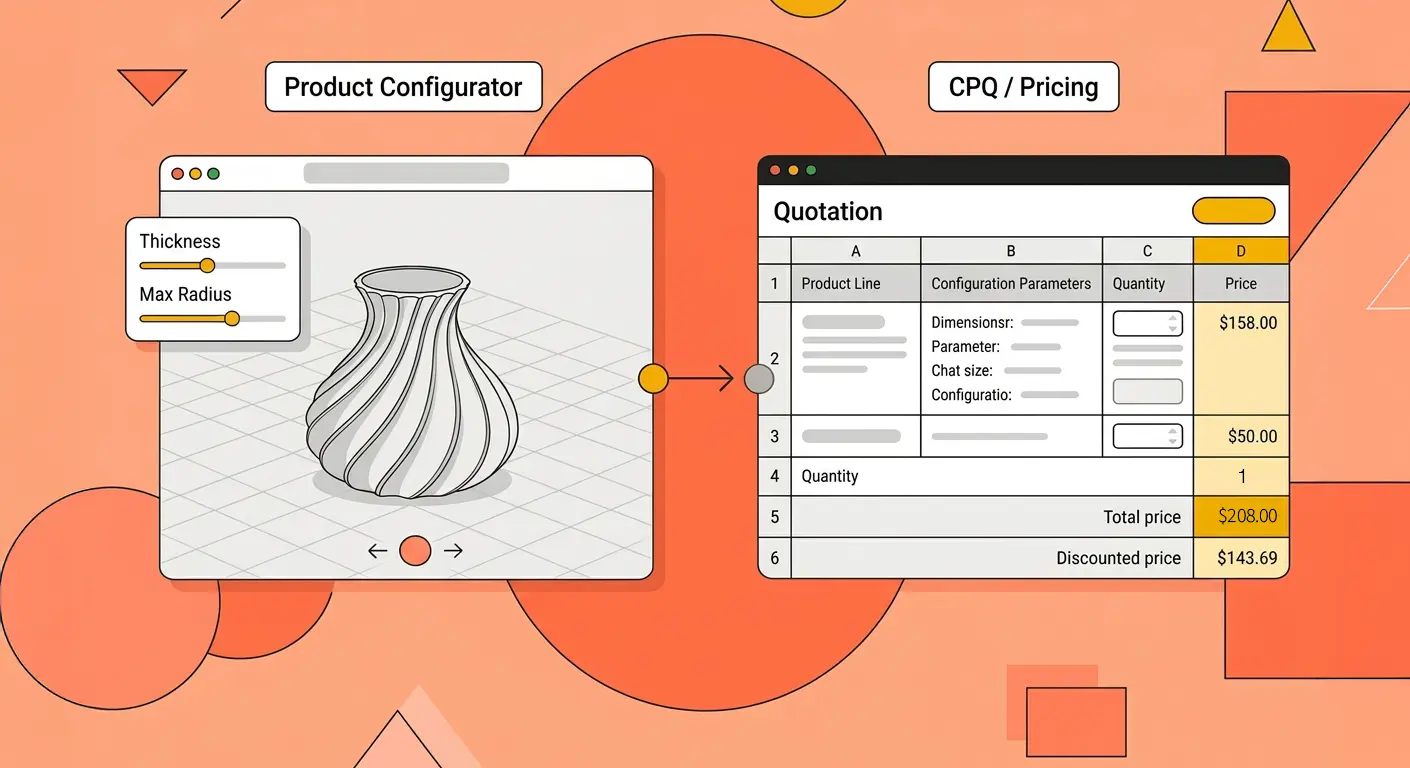
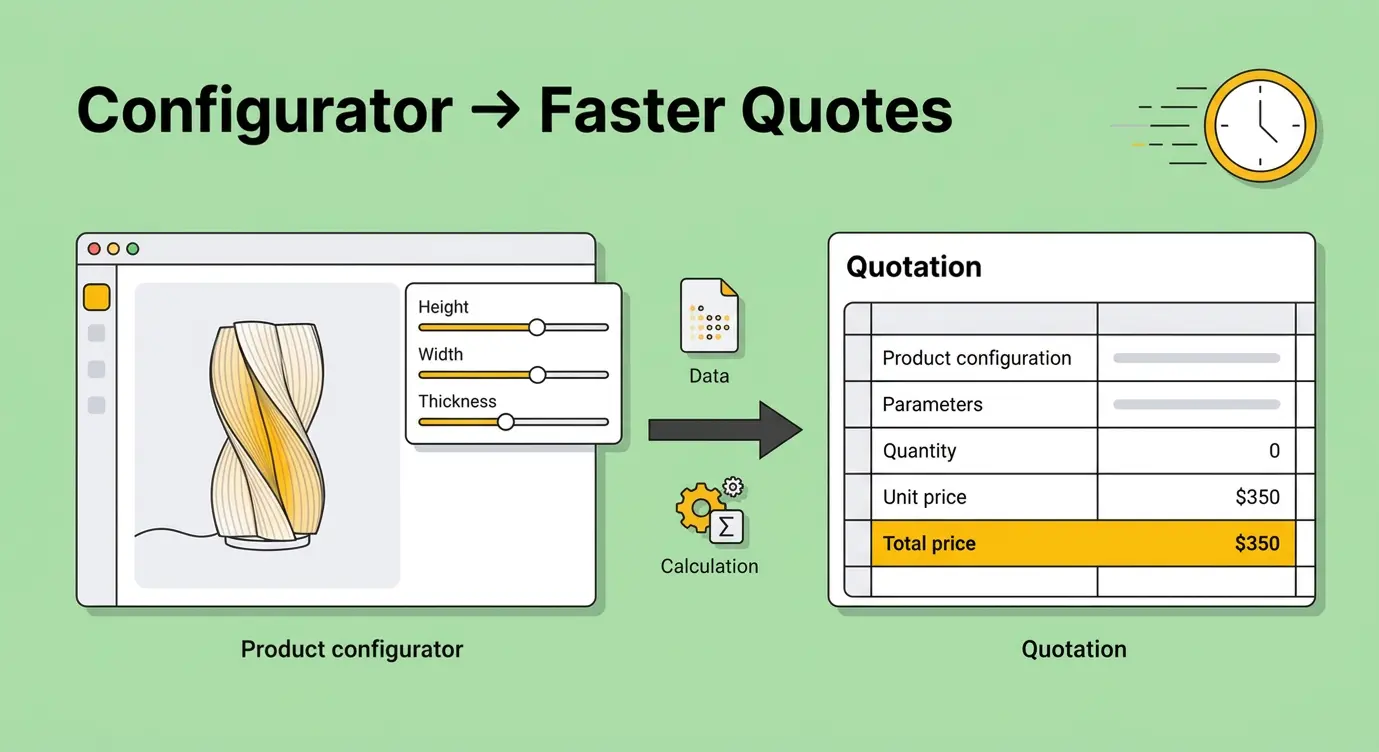
A product configurator replaces the manual quoting workflow entirely. Instead of a sales rep assembling a quote from scattered data sources, the configurator presents every valid option to the customer (or the rep) through a guided interface. Pricing rules, material constraints, dimensional limits, and compatibility logic are all embedded in the tool. The moment a customer selects an option, the price updates. The moment they finalize a configuration, the quote is ready.
This is not theoretical. Industry CPQ data shows that teams using configure-price-quote systems generate quotes 10 times faster and cut approval times by up to 95%. CPQ software eliminates 40% of human errors in configuration and quoting processes. In manufacturing environments specifically, quoting errors drop by up to 36%.
For many product categories, the customer can do this entirely through self-service. A buyer configuring a custom shelf, cabinet, or modular product doesn't need to call anyone. They select their dimensions, materials, and features, see the price update in real time, and place the order. The sales team is only involved when human judgment adds value — complex enterprise deals, bulk pricing negotiations, or technical consultations. Understanding how real-time pricing works inside configurators explains the mechanics behind this instant quoting capability.
The Impact on Sales Cycle Length
When quoting goes from days to seconds, the entire sales cycle compresses. Aberdeen Group research cited by Salesforce found that organizations using CPQ software experience a 28% reduction in sales cycle length. CPQ users report an average sales cycle of 3.42 months compared to 4.68 months for non-CPQ users — a difference of more than five weeks per deal.
That compression means more deals per quarter with the same team. Aberdeen's data also shows that CPQ users achieve 49% higher proposal volume per representative per month. When reps aren't spending two days assembling a quote, they can respond to more inquiries, follow up on more leads, and progress more deals simultaneously.
The deal size impact is equally striking. Companies using CPQ solutions have an average deal size 105% larger than companies without them. Best-in-class CPQ users achieve 5 times greater year-over-year revenue growth — 15.7% compared to 2.6% for businesses without configuration tools. These numbers, drawn from our detailed analysis of configurator ROI, reflect the compounding effect of faster cycles, larger deals, and higher proposal volume.
From Order-Takers to Consultants
The most profound impact of configurators on sales teams is qualitative, not just quantitative. When a configurator handles product selection, pricing, validation, and quote generation, the sales rep's role shifts. They stop being an order-taker who manually processes requests. They become a consultant who helps customers solve problems.
This matters because consultative selling drives larger deals. When a rep doesn't need to spend 45 minutes building a quote in Excel, they can spend that time understanding the customer's actual needs, recommending configurations that deliver better outcomes, and identifying upsell opportunities that the customer would never have discovered on their own. The difference between a standalone configurator and a full CPQ system often comes down to how deeply these guided selling capabilities are integrated.
Guided Selling: The Configurator as Sales Assistant
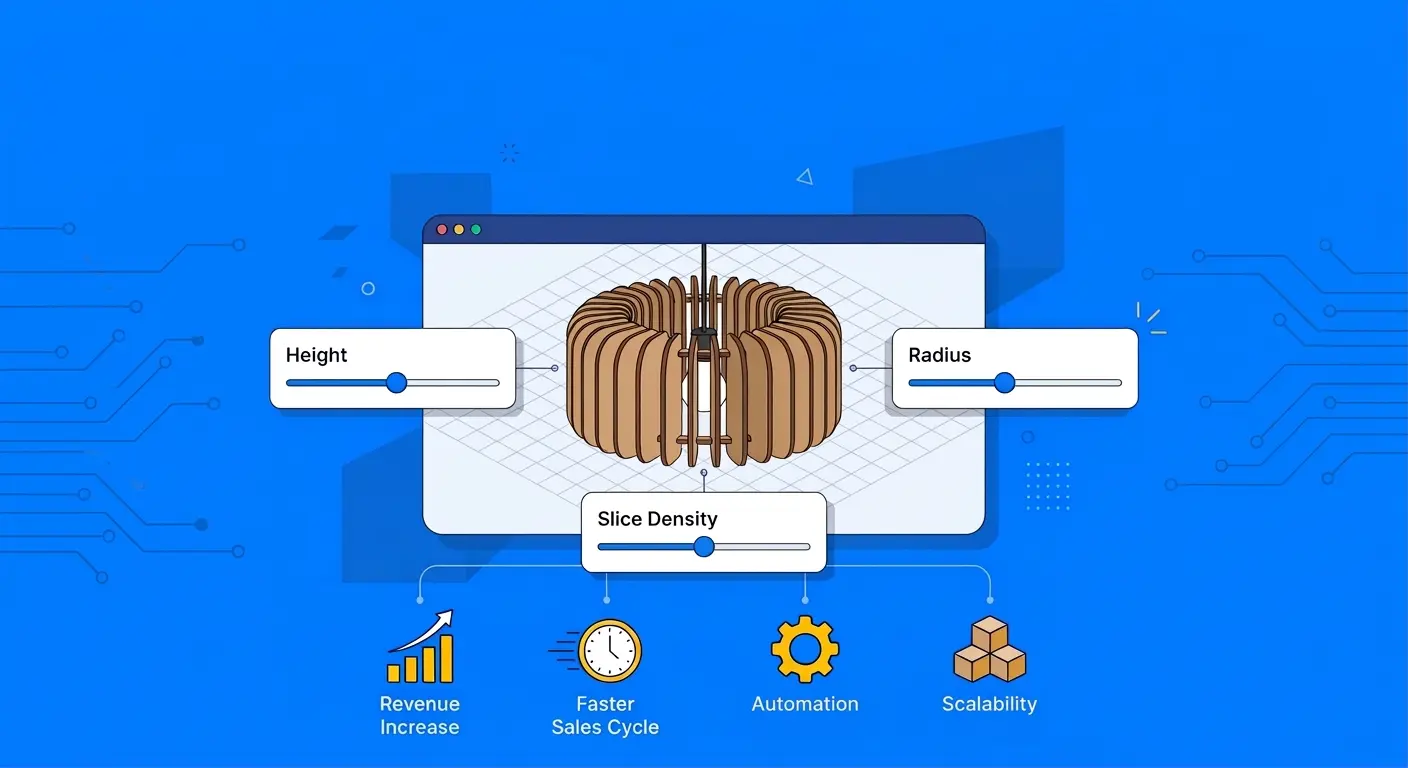
Modern configurators don't just present options — they guide decisions. Rule-based logic ensures customers (or reps using the tool internally) can only select compatible combinations. If a customer picks a material that doesn't support their chosen dimensions, the configurator flags it immediately rather than letting an incompatible order reach manufacturing.
This guided selling capability is particularly valuable for businesses with complex product lines. A sales rep covering hundreds of SKUs with thousands of possible combinations cannot memorize every constraint. The configurator acts as an always-current, always-accurate product expert. It knows which options work together, which require upcharges, and which are unavailable — eliminating the "let me check and get back to you" delays that kill momentum in sales conversations.
For companies scaling their customization operations, guided selling solves the knowledge transfer problem. New hires don't need months of product training before they can generate accurate quotes. The configurator encodes the expertise, and the rep provides the relationship.
Quote Accuracy and Customer Trust
Inaccurate quotes damage more than margins. They damage trust. When a customer receives a quote, places an order, and then gets a revised invoice because the original pricing was wrong, that relationship suffers. In B2B contexts where deals are worth tens or hundreds of thousands of dollars, a single pricing error can cost a customer permanently.
Configurators enforce pricing accuracy structurally. Every rule, every surcharge, every volume discount is codified in the system. There is no room for a sales rep to accidentally apply last quarter's pricing or forget a setup fee. Research on CPQ impact confirms that configuration accuracy in complex industries has improved by 47% with CPQ adoption. That accuracy translates directly into customer confidence and repeat business.
CRM and ERP Integration: Closing the Loop
A configurator's value multiplies when it connects to the systems your business already runs on. When integrated with a CRM, every configuration a customer explores becomes a data point — which options are popular, where customers drop off, which upgrades convert. Sales managers gain visibility into pipeline health based on actual configuration activity, not just rep-reported forecasts.
ERP integration closes the loop between sales and production. A configured order flows directly from the customer's screen to the factory floor without manual re-entry. This eliminates transcription errors, reduces lead times, and ensures that what was quoted is exactly what gets built. For manufacturers, this connection between design and fabrication through configurator production data is where the largest operational savings emerge.
Understanding what a product configurator actually is and how it fits into your existing tech stack is the first step toward realizing these integration benefits.
How Configurator.tech Bridges Sales and Production
Configurator.tech is built specifically for this use case: giving sales teams a tool that eliminates manual quoting while generating production-ready output. Customers or reps configure products through a visual, rule-driven interface. Pricing updates instantly. The resulting configuration includes all specifications needed for manufacturing — dimensions, materials, finishes, and assembly instructions — so nothing is lost in translation between the sale and the shop floor.
For sales teams, this means faster quotes, fewer errors, and more time selling. For operations teams, it means fewer rework orders and clearer production schedules. For the business as a whole, it means shorter cycles, larger deals, and a sales force that can scale without proportional headcount increases.
Explore the pricing plans to see how the platform fits your team's needs, or contact us to discuss how a configurator can transform your sales workflow.