
'%3e%3cpath%20d='M15.1003%2043.5001C33.2091%2043.5001%2043.1166%2028.4935%2043.1166%2015.4838C43.1166%2015.062%2043.1072%2014.6307%2043.0884%2014.2088C45.0157%2012.815%2046.679%2011.0886%2048%209.11072C46.205%209.90932%2044.2993%2010.4309%2042.3478%2010.6576C44.4026%209.42594%2045.9411%207.49107%2046.6781%205.21166C44.7451%206.35724%2042.6312%207.16535%2040.4269%207.60134C38.9417%206.02324%2036.978%204.97835%2034.8394%204.62822C32.7008%204.27809%2030.5064%204.64222%2028.5955%205.66431C26.6846%206.68641%2025.1636%208.30953%2024.2677%2010.2827C23.3718%2012.256%2023.1509%2014.4694%2023.6391%2016.5807C19.725%2016.3843%2015.8959%2015.3675%2012.4%2013.5963C8.90405%2011.8251%205.81939%209.339%203.34594%206.29916C2.0888%208.46661%201.70411%2011.0314%202.27006%2013.4723C2.83601%2015.9132%204.31013%2018.047%206.39281%2019.4401C4.82926%2019.3905%203.29995%2018.9695%201.93125%2018.212V18.3338C1.92985%2020.6084%202.7162%2022.8133%204.15662%2024.5737C5.59704%2026.334%207.60265%2027.5412%209.8325%2027.9901C8.38411%2028.3864%206.86396%2028.4441%205.38969%2028.1588C6.01891%2030.115%207.24315%2031.8259%208.89154%2033.0528C10.5399%2034.2797%2012.5302%2034.9613%2014.5847%2035.0026C11.0968%2037.7423%206.78835%2039.2284%202.35313%2039.2213C1.56657%2039.2201%200.780798%2039.1719%200%2039.077C4.50571%2041.9676%209.74706%2043.5029%2015.1003%2043.5001Z'%20fill='%23F7F7F7'/%3e%3c/g%3e%3cdefs%3e%3cclipPath%20id='clip0'%3e%3crect%20width='48'%20height='48'%20fill='white'/%3e%3c/clipPath%3e%3c/defs%3e%3c/svg%3e)


Every business needs signs. From the channel letters above a retail storefront to the wayfinding system inside a hospital, signage is a universal product category with near-infinite customisation requirements. Yet the industry still operates largely through manual quoting processes: customers describe what they want, sales reps create mockups, revisions go back and forth, and only then does production begin. Product configurators are changing this — letting customers design their signs in real time, see photorealistic 3D previews, and receive instant pricing.
According to Grand View Research, the global signage market was valued at $32.1 billion in 2024 and is projected to grow at a 7.1% CAGR through 2030. The growth is driven by urbanisation, retail expansion, and the increasing importance of brand visibility. For sign manufacturers and distributors, a configurator that automates the design-to-quote process is a significant competitive advantage.
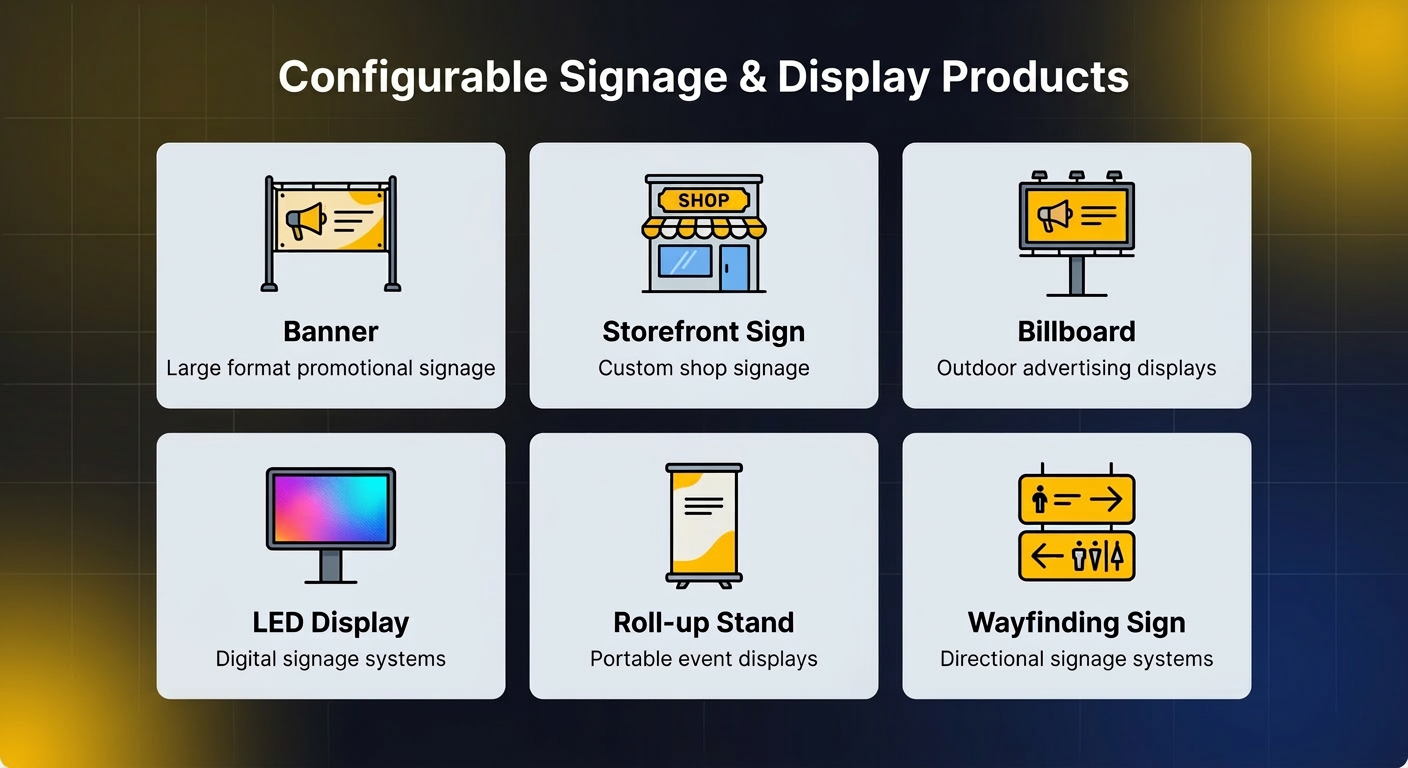
Types of Signage That Benefit from Configurators
Signage is one of the most varied product categories in manufacturing. A single sign company may produce:
- Channel letters: Individual illuminated letters mounted on building facades. Each letter requires specific dimensions, material (aluminum, stainless steel, acrylic), face type (standard, reverse-lit, halo-lit), and LED colour selection.
- Monument signs: Freestanding ground-level signs for business parks, hotels, and institutions. These involve base material, sign panel dimensions, lighting, and double-sided options.
- Wayfinding systems: Directional signage for hospitals, airports, and campuses. These require consistency across dozens of individual signs with shared design language but unique content and dimensions.
- Trade show displays: Portable exhibition stands, banner walls, and counter displays. Customers configure size, graphics, lighting, and accessory packages.
- Retail displays: Point-of-purchase stands, shelf talkers, and window graphics. These often involve branded templates with customisable dimensions and graphics.
Each category involves different materials, production processes, and pricing models — but all share the need for dimensional accuracy, material visualisation, and production-ready output. A product configurator handles this complexity in a way that static order forms and PDF catalogues cannot.
How Signage Configurators Work
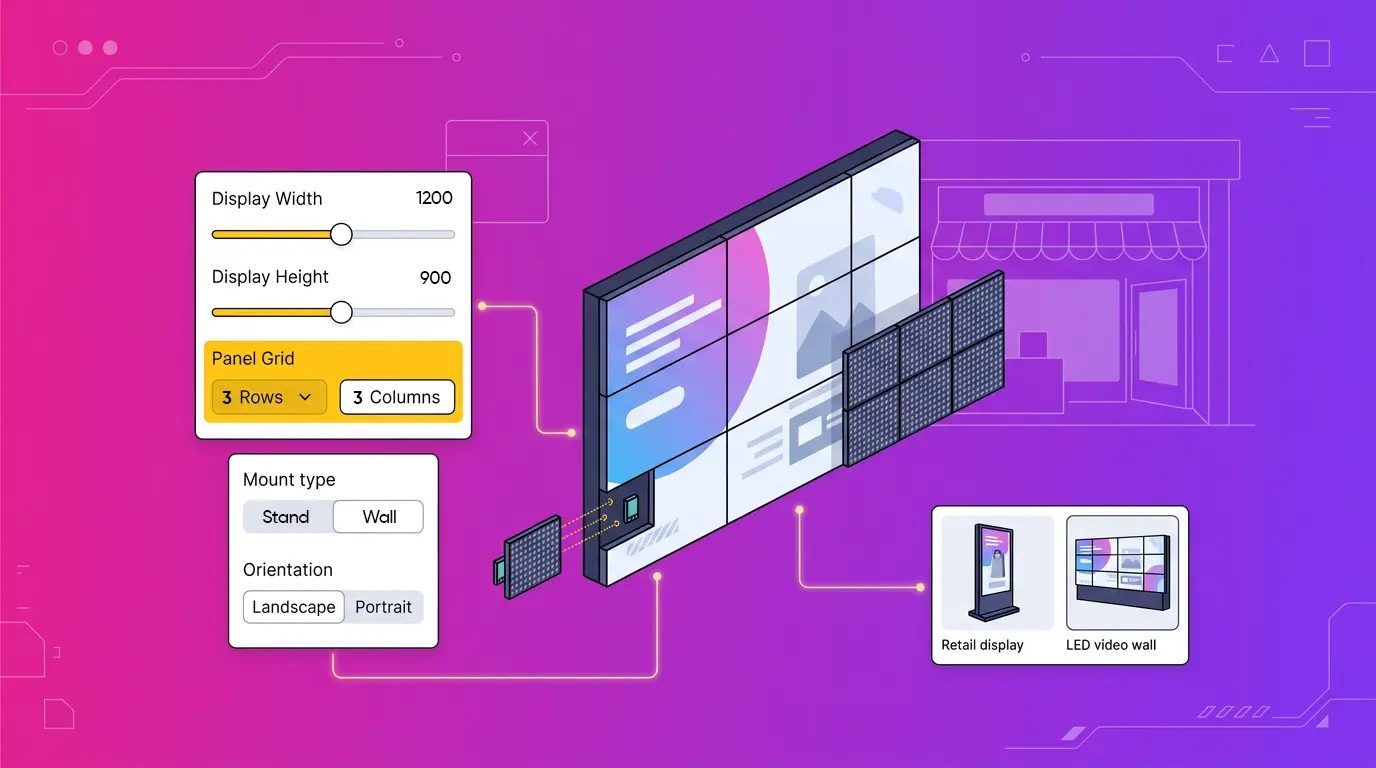
A signage configurator lets customers build their sign step by step. For channel letters, the customer types their business name, selects a font, chooses the letter height and depth, picks the material and finish, selects illumination type (front-lit, back-lit, edge-lit), and specifies mounting method. The configurator renders each letter in 3D, showing exactly how the sign will look — including how the lighting will appear at night.
Built-in rules prevent invalid configurations. A letter with too narrow a stroke width for the chosen depth is flagged. A material that is unavailable in the requested colour prompts a suggestion. Minimum and maximum dimensions enforce structural integrity. This guided experience ensures every order is manufacturable, which is critical in an industry where custom remakes are expensive.
Colour Matching: Pantone and RAL
Colour accuracy is critical in signage. A brand's logo colour must match exactly — a red that is slightly too orange is unacceptable. Signage configurators integrate with colour systems like Pantone (PMS) and RAL to ensure the colour selected on screen matches the colour produced in the factory. The configurator renders the selected colour under different lighting conditions (daylight, artificial light, illuminated at night) so customers can validate the colour before approving.
This colour matching capability extends to multi-material signs where different components (metal frame, acrylic face, vinyl graphics) need to achieve visual colour consistency despite being made from different materials with different colour processes. The configurator handles the translation between paint codes, vinyl colour references, and acrylic tint specifications.
Production Output for Sign Manufacturing
Sign manufacturing involves CNC routers, laser cutters, vinyl plotters, and LED assembly — each requiring specific file formats and specifications. A well-built configurator generates all of these automatically from the customer's design:
- CNC files: DXF or DWG files for routing aluminum, acrylic, and composite panels.
- Cut files: Vector paths for vinyl plotters and laser cutters.
- LED layouts: Module spacing, power supply specifications, and wiring diagrams.
- Installation drawings: Mounting hole positions, structural requirements, and electrical connections.
- Bills of materials: Complete component lists with quantities and supplier part numbers.
This design-to-fabrication pipeline eliminates the hours-long process of a drafter manually creating production drawings from a sales order. The customer's design goes directly from the browser to the shop floor, with every dimension and specification intact.
Real-Time Pricing for Complex Signs
Signage pricing is notoriously complex. A single set of channel letters involves material costs (per letter, based on size and depth), LED costs (based on illumination type and letter count), fabrication time (based on complexity), finishing costs (painting, polishing), and installation considerations. Manual quoting for a single job can take 30 minutes to an hour.
A configurator calculates all of this in real time. As the customer adjusts letter height from 12 inches to 24 inches, the price updates instantly to reflect increased material, LED modules, and fabrication time. Real-time pricing transforms the sales cycle from days (submit inquiry, wait for quote, negotiate, revise) to minutes (configure, review price, order). For sign companies processing hundreds of quotes monthly, this is a transformative efficiency gain.
B2B Sales Workflow
Signage is primarily a B2B business. Sign companies sell to business owners, architects, property managers, and franchisees. A configurator designed for this audience includes features that B2C tools typically lack: saved configurations that can be shared with stakeholders for approval, multi-sign projects where consistent branding is applied across a set of signs, dealer and franchise portals with pre-approved templates and pricing, and purchase order integration with approval workflows.
For franchise operations, the configurator ensures brand consistency across locations. A franchise HQ defines approved fonts, colours, materials, and layouts. Individual franchisees configure their signs within those guardrails, ensuring every location matches the brand standard while accommodating local size and mounting requirements.
How Configurator.tech Serves Signage Companies
Configurator.tech provides the parametric 3D engine that signage configurators require. Our platform handles dimensional configuration with structural validation, photorealistic material and lighting rendering, real-time pricing with complex multi-component calculations, and production-ready file output for CNC, laser, and vinyl cutting. The waste reduction benefits are significant in an industry where material scrap from incorrect orders is a constant cost centre.
Explore our prebuilt configurator templates to see parametric product configuration in action, or contact our team to discuss how a signage configurator can streamline your quoting and production workflow.